Sleep Optimization and Recovery for Fathers Over 35
78% of exercisers now cite mental and emotional well-being as their top reason for working out, ahead of appearance. That shift tells you everything you need to know about where we are as a culture. Men are finally waking up to the fact that the external transformation means nothing if the internal systems are breaking down. And the first system that breaks when you ignore it is sleep. For fathers over 35, sleep optimization and recovery is not a nice to have. It is the bridge between showing up in the gym and actually getting results. You can train hard, eat clean, and do everything right during your waking hours. But if you are not sleeping, you are building on sand.
Why Sleep Determines Your Results After 35
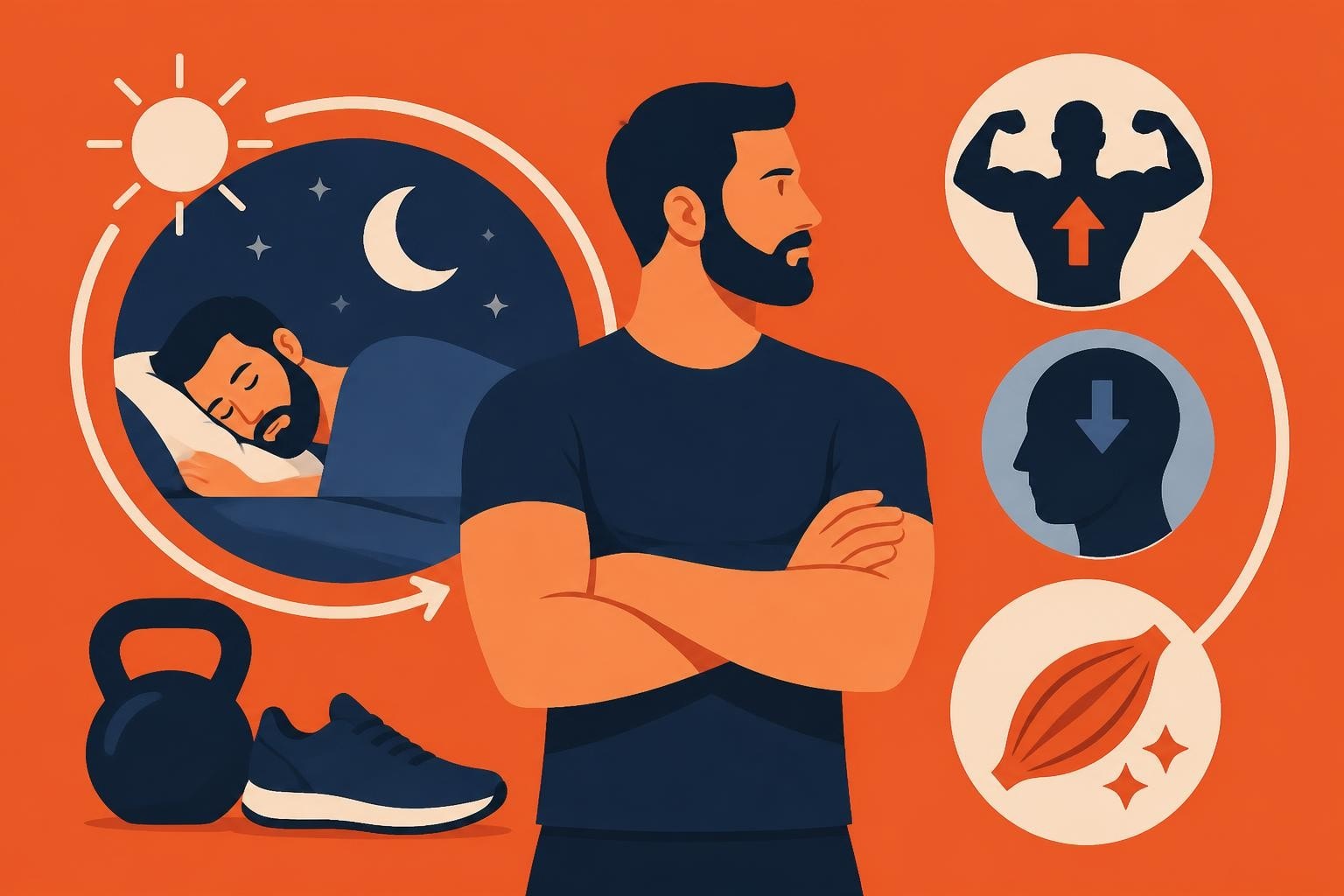
Your body does not build muscle in the gym. It breaks muscle down in the gym. The actual growth, the repair, the hormonal reset, all of that happens when you sleep.Sleep physiologyshows us that deep sleep and REM cycles are where your body produces growth hormone, consolidates memory, and repairs tissue damage from training. Miss those cycles consistently and you are training for nothing.
After 35, your margin for error shrinks. You cannot recover like you did at 25. Your testosterone is already declining naturally, roughly 1% per year after 30. Poor sleep accelerates that drop. One week of sleep restriction, five hours per night, can lower testosterone by 10-15% in healthy young men. For men over 35 who are already facing natural decline, that is a crisis.
The Hormonal Cost of Bad Sleep
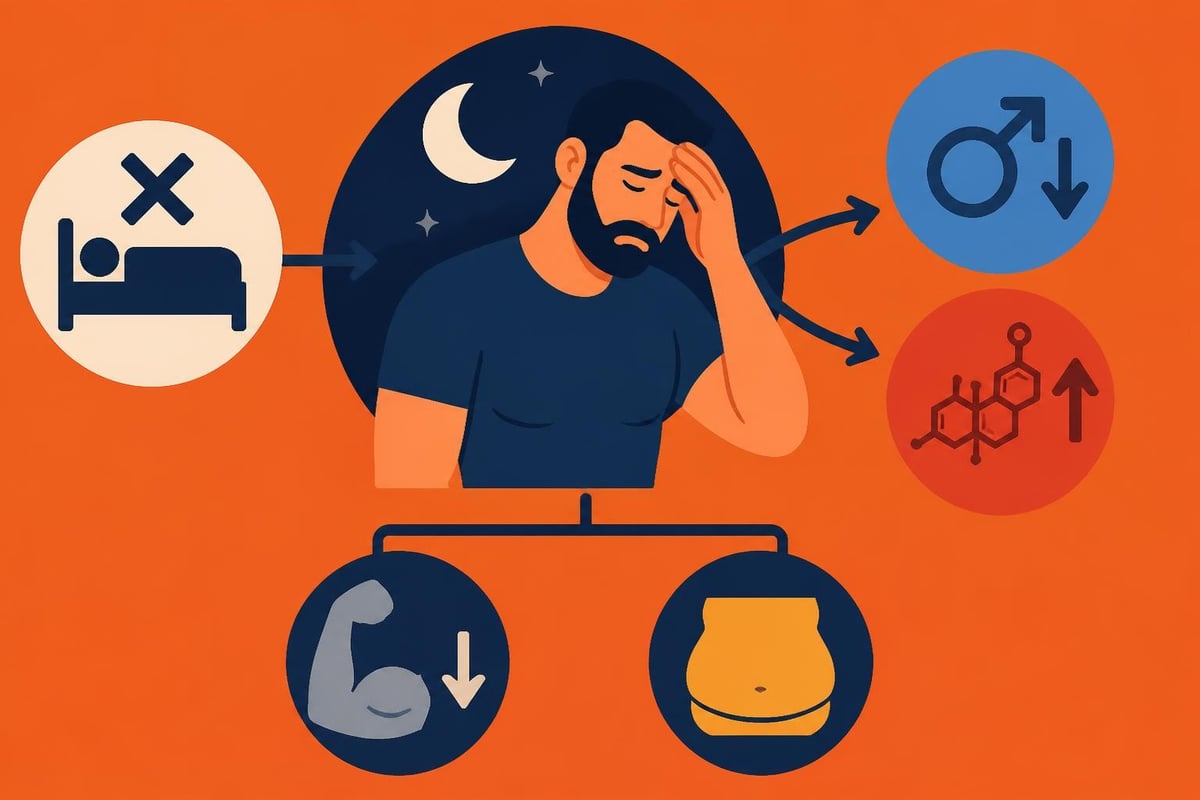
Sleep deprivation destroys your hormonal environment in two directions. First, it lowers testosterone. Second, it raises cortisol. Cortisol is your stress hormone. It has a job to do. But when it stays elevated because you are chronically under-slept, it becomes catabolic. It breaks down muscle tissue, stores fat around your midsection, and keeps you in a state of low-grade inflammation.
Here is what happens on a biochemical level when you do not sleep:
Testosterone drops: Less deep sleep means less growth hormone and testosterone production during the night
Cortisol spikes: Your body interprets sleep deprivation as a survival threat and keeps stress hormones elevated
Insulin sensitivity declines: Poor sleep makes your body less efficient at processing carbohydrates, leading to fat storage
Ghrelin increases: The hunger hormone goes up, making you crave junk food and overeat
Leptin decreases: The satiety hormone drops, so you never feel full
You cannot out-train bad sleep. You cannot out-eat it either. The hormonal damage from chronic sleep deprivation will undo every good decision you make during the day.
Wearable Technology and Sleep Tracking
I wear an Oura Ring. Some of my clients use WHOOP. Others track nothing and just go by how they feel. All three approaches can work, but the wearables give you data that cuts through your own denial. You think you slept seven hours. Your ring says you got five and a half, with only 45 minutes of deep sleep. That gap between perception and reality is where most men live.
The value of wearables is not in obsessing over scores. It is in establishing baselines and identifying patterns. When you see your heart rate variability drop three days in a row, you know you are pushing too hard. When your deep sleep percentage falls below 15%, you know your recovery is compromised. When your resting heart rate climbs five beats above baseline, you know something is off.
What to Track and Why
MetricWhat It Tells YouTarget RangeTotal Sleep TimeRaw hours in bed asleep7-9 hoursDeep Sleep %Physical recovery and growth hormone release15-25% of total sleepREM Sleep %Cognitive recovery and emotional regulation20-25% of total sleepResting Heart RateOverall recovery status and stress load40-60 bpm (varies by fitness level)Heart Rate VariabilityNervous system balance and readiness to trainHigher is better (baseline is individual)
Do not let the data own you. Use it to make adjustments. If your HRV is low and your sleep was poor, maybe you skip the heavy deadlift session and do recovery work instead. That is intelligent training. That is how you stay in the game long-term.
Practical Sleep Habits That Work for Fathers
I train at 5 AM. That means I am in bed by 9. My clients laugh when I tell them that. Then they try it for two weeks and their lifts go up, their mood stabilizes, and their wives notice the difference. The biggest obstacle to sleep optimization and recovery for fathers is not lack of knowledge. It is lack of commitment to a non-negotiable standard.
You know what good sleep requires. You have read the articles. You have heard the advice. But you are still scrolling at 11 PM, or watching another episode, or doing work email in bed. That is not an information problem. That is a leadership problem. You would not let your kids stay up until midnight on a school night. Hold yourself to the same standard.
The 90-Minute Rule
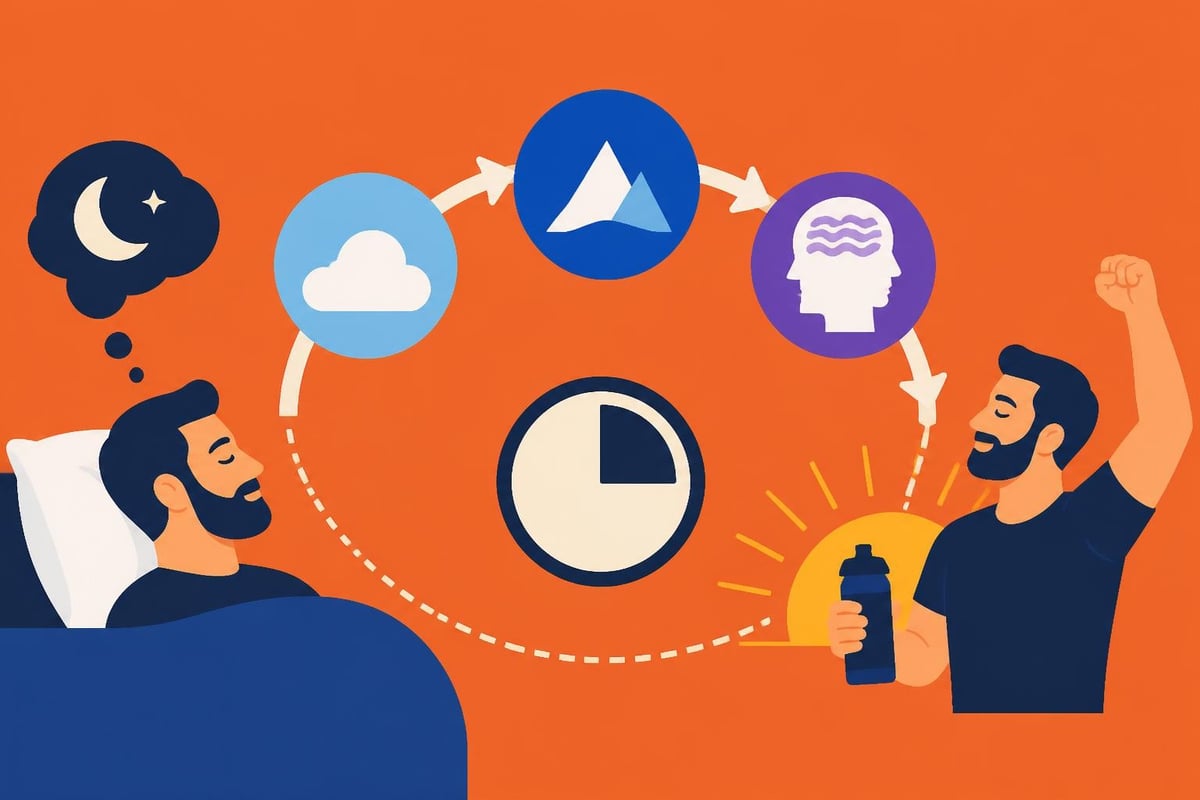
Sleep happens in 90-minute cycles. Each cycle moves through light sleep, deep sleep, and REM. If you wake up in the middle of deep sleep, you feel terrible. If you wake up at the end of a cycle, you feel decent even on less total sleep. Plan your sleep in 90-minute blocks. If you need to be up at 5 AM, work backward: 5 AM minus 7.5 hours (five cycles) puts you in bed by 9:30 PM, asleep by 10 PM.
Most fathers need 7.5 to 9 hours. That means five to six full cycles. You might think you function fine on six hours. You are wrong.Research on sleep and athletic performanceconsistently shows that even partial sleep deprivation degrades reaction time, strength output, and decision-making. You are operating below your capacity and calling it normal.
The Realistic Sleep Protocol for Dads
You have young kids. You have early work obligations. You have a wife who wants to talk to you after the kids go down. I get it. Here is what actually works when your environment is not perfect.
The Non-Negotiable Foundation
Set a wake time and do not move it: Even on weekends.Sleep regularityis more important than total hours. Your body needs predictability.
Work backward eight hours: That is your target bedtime. Protect it like you protect your training time.
Start your wind-down 90 minutes before bed: Dim the lights, stop eating, finish work, put the phone on do not disturb.
Cool your bedroom to 65-68 degrees: Your core body temperature needs to drop to initiate sleep. A hot room fights that process.
Make your room dark: Blackout curtains or a sleep mask. Any light exposure suppresses melatonin production.
You will not hit this perfectly every night. That is fine. The goal is consistency, not perfection. If you execute this protocol five nights out of seven, you are ahead of 90% of men your age.
When Kids Interrupt Sleep
You cannot control a newborn's sleep schedule. You cannot always prevent a toddler from waking up at 2 AM. What you can control is how you respond and what you do with the sleep you can get.
Split shifts with your wife: One of you handles early wake-ups, the other handles late. Rotate weekly.
Nap when possible: A 20-minute nap in the afternoon can offset some sleep debt. Do not go longer than 30 minutes or you will feel worse.
Protect your sleep opportunity: If you only have a six-hour window, do not waste an hour of it on your phone.
Some men use interrupted sleep as an excuse to give up entirely. That is the wrong move. Optimize what you can control. The season of young kids does not last forever. But the habits you build now will carry you through the rest of your life. For personalized support on building these habits into a sustainable routine, the1-on-1 Men's Coachingat The Father Forge provides custom programming and weekly accountability designed for fathers who refuse to settle for low standards.
What Kills Sleep Quality
Most sleep advice focuses on what to add. I focus on what to remove. Subtraction is more powerful than addition when it comes to sleep optimization and recovery.
Alcohol: You think it helps you fall asleep. It does. But it destroys your sleep architecture. Alcohol suppresses REM sleep and keeps you in lighter stages. You wake up feeling unrested because you never cycled through the deep recovery phases. If you drink, stop at least three hours before bed and limit yourself to one drink.
Caffeine after noon: Caffeine has a half-life of five to six hours. If you drink coffee at 2 PM, a quarter of that caffeine is still in your system at 2 AM. It blocks adenosine receptors, which are what make you feel sleepy. Cut off caffeine by noon, earlier if you are sensitive.
Blue light exposure: Your phone, TV, and computer emit blue light that tells your brain it is daytime. This suppresses melatonin, the hormone that initiates sleep. Use blue light blocking glasses after sunset or switch your devices to night mode. Better yet, put the screens away entirely after 8 PM.
Late heavy meals: Digestion raises your core body temperature, which is the opposite of what you need to fall asleep. Eat your last big meal at least three hours before bed. If you need something, keep it light and protein-based.
Inconsistent schedule: Going to bed at 10 PM on weekdays and 1 AM on weekends confuses your circadian rhythm. Your body does not know when to release melatonin or cortisol.The American Academy of Sleep Medicineemphasizes that regularity matters more than duration for long-term health.
Sleep and Training Performance
Sleep interventions for athletic performanceshow clear results. When athletes extend sleep to 9-10 hours per night, sprint times improve, accuracy increases, and reaction times drop. When sleep is restricted below seven hours, the opposite happens. Strength decreases, endurance suffers, and injury risk climbs.
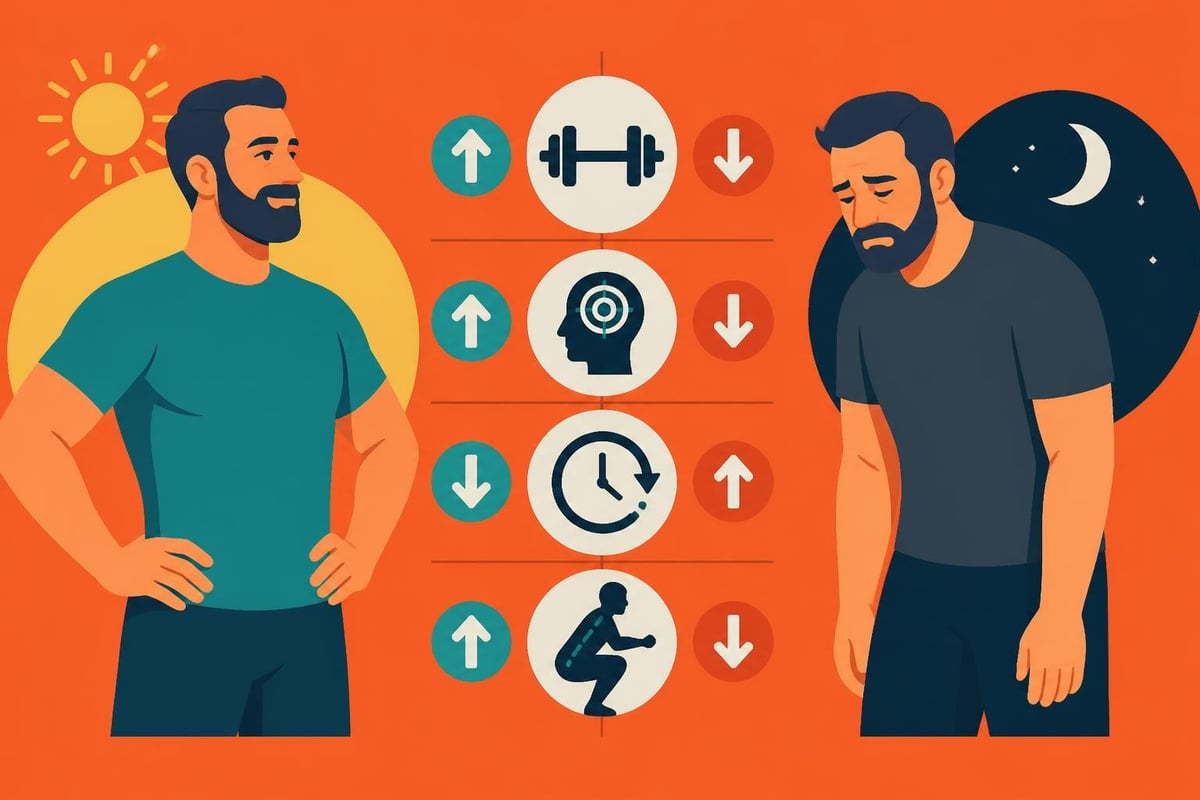
For fathers over 35 who train early in the morning, this is not academic. This is the difference between a productive session and going through the motions. If you walked into the gym on five hours of sleep, your central nervous system is compromised. Your motor unit recruitment is impaired. You will not be able to generate the same force output. Your form will break down under load. You are training yourself to move poorly while fatigued, which builds bad patterns and increases injury risk.
Signs Your Sleep Debt Is Killing Your Training
You need more warm-up sets than usual to feel ready
Weights that felt manageable last week feel heavy today
Your grip strength is noticeably weaker
You lose focus mid-set or forget your rep count
You feel irritable or short-tempered in the gym
Recovery between sets takes longer than normal
If you see two or more of these signs consistently, your sleep is the problem. Do not add another supplement. Do not change your program. Fix your sleep first.
The Brotherhood Factor in Sleep Accountability
You will not fix your sleep alone. You need external accountability. This is why group coaching environments work. When you tell another man that you are committing to a 9 PM bedtime, and he checks in on you three days later, you are more likely to follow through. Accountability removes the option to negotiate with yourself at 10:30 PM when you want to stay up.
AtThe Father Forge, we track sleep alongside training and nutrition. It is not optional. It is part of the standard. Men report their sleep data in the weekly check-ins. When someone's numbers drop, we address it immediately. Not with judgment, but with problem-solving. What changed? What is in the way? What needs to be adjusted?
This is how you build sustainable change. Not through willpower. Not through motivation. Through structure, repetition, and brotherhood. Sleep optimization and recovery becomes a shared standard, not an individual struggle.
FAQ: Sleep Optimization and Recovery for Fathers
How much sleep do I actually need if I am training hard?
You need seven to nine hours of actual sleep time, not time in bed. If you are training five to six days per week with intensity, aim for the higher end. Your body requires more recovery time to adapt to the training stress. Less than seven hours consistently will undercut your results no matter how good your program is.
What if I can only get six hours because of my work schedule?
Then you have a priority problem, not a time problem. If your work schedule makes adequate sleep impossible, something needs to change. That might mean going to bed earlier, adjusting your training volume, or having a hard conversation with your employer about sustainable performance. You cannot build a strong body on a broken foundation. Six hours is not enough for optimal recovery in men over 35.
Should I take melatonin or other sleep supplements?
Melatonin can help reset your circadian rhythm if you are traveling or adjusting to a new schedule. It is not a long-term solution for chronic sleep problems. Magnesium glycinate, 400-500mg before bed, can improve sleep quality by supporting nervous system relaxation. But supplements do not fix poor sleep hygiene. Fix the behaviors first. Add supplements only after you have dialed in your environment and habits.
Is it better to train tired or skip the workout and sleep in?
It depends on the workout and how sleep-deprived you are. If you got five hours of sleep and you have a heavy squat session programmed, skip it. Trade it for a recovery walk or light mobility work. If you got six and a half hours and the workout is moderate intensity, go train but reduce the volume slightly. One bad night will not destroy you. Three or four bad nights in a row means you need to back off training intensity until your sleep stabilizes.
How long does it take to see results from better sleep?
You will feel subjective improvements within three to five days. Mood stabilizes, energy improves, training feels smoother. Objective improvements in body composition, strength, and hormonal markers take two to four weeks of consistent sleep. Your body needs time to recalibrate. Do not expect overnight changes. Commit to the standard and let the results build over time.
Sleep optimization and recovery is not a hack. It is a leadership decision. You decide that your health, your performance, and your family deserve better than a man running on fumes. The Father Forge builds custom fitness and mindset programs tailored to your specific situation, whether that is managing young kids, high-stress work, or decades of neglecting recovery. If you are ready to stop negotiating with yourself and start executing a real standard,The Father Forgeprovides the structure, accountability, and brotherhood to make it happen.