Peptides for Recovery: What Fathers Need to Know
The conversation around peptides for recovery has moved from niche athletic circles into mainstream fitness culture. Fathers over 35 who train hard, work demanding jobs, and carry the weight of family leadership are asking whether these compounds offer a legitimate edge in tissue repair, joint health, and training capacity. The question is not whether peptides exist or whether some people use them. The question is whether you possess the information, discernment, and accountability structure to make a decision that aligns with your values and protects your health. This article addresses peptides for recovery from a principle-centered position: what the evidence shows, what the gaps are, and what obligations you carry when considering any intervention that alters your biology.
What Peptides for Recovery Actually Are
During my APFT, I tore my bicep, and the pain was excruciating. To speed up my recovery, I turned to BPC-157 and TB-500, peptides known for their healing properties. These short chains of amino acids felt like my secret weapons, signaling my body to heal and grow stronger. With every day, I could feel the inflammation subsiding, and I was determined to get back to full strength.
The most commonly cited recovery peptides include BPC-157, TB-500 (thymosin beta-4), and growth hormone secretagogues like ipamorelin or CJC-1295. Each targets different pathways. BPC-157 is promoted for tendon and ligament repair. TB-500 is claimed to accelerate wound healing and reduce inflammation. Growth hormone peptides are marketed to increase endogenous GH secretion, which theoretically supports muscle recovery and fat metabolism.
The Appeal and the Problem
The appeal is straightforward. You train hard. You are accountable to your family. You cannot afford to lose weeks to an injury or months to slow recovery. A substance that accelerates healing sounds like responsible stewardship of your body.
The problem is equally straightforward. Most recovery peptides exist in a regulatory gray zone. They are not approved by the FDA for human use outside narrow clinical contexts. Preclinical studies on BPC-157 show promise in animal models for musculoskeletal repair, but human evidence is limited to case reports and anecdotal claims. The gap between laboratory results and clinical validation is where risk lives.
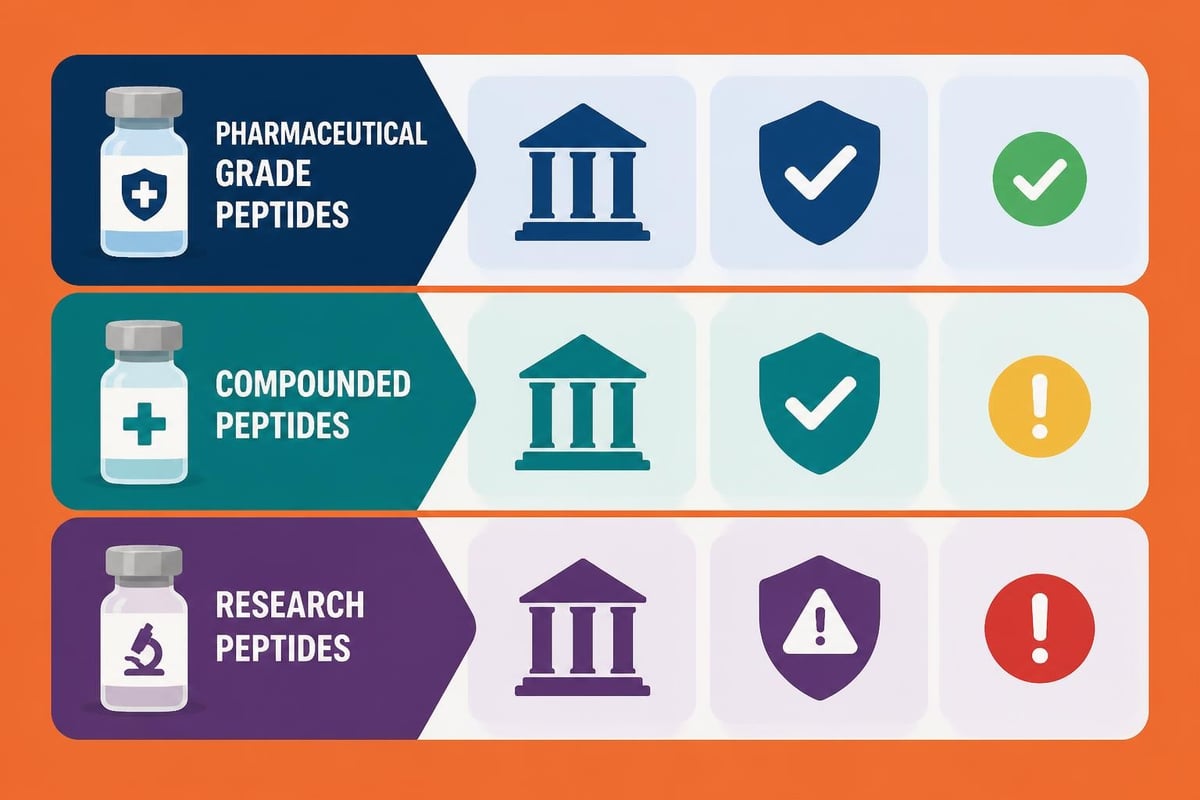
Key distinctions to understand:
Pharmaceutical-grade peptides undergo rigorous manufacturing, purity testing, and regulatory oversight.
Research peptides sold online often lack third-party verification, may contain impurities, and carry no guarantee of sterility or accurate dosing.
Compounded peptides from telehealth providers occupy a middle ground, with variable quality control depending on the source.
The Current Evidence Base for Recovery Peptides
The scientific literature on peptides for recovery is expanding but incomplete. A 2024 narrative review of BPC-157 summarizes what we know: animal studies demonstrate effects on tendon healing, gastric protection, and angiogenesis, but human trials are scarce. The mechanisms proposed involve modulation of growth factors, nitric oxide pathways, and inflammatory mediators. These are plausible. They are not proven at the doses and durations people actually use.
Thymosin beta-4 has a more developed clinical track record. Human trials registered on ClinicalTrials.gov have explored TB-500 for wound healing and cardiac repair. Results are mixed, and none of the completed studies support the broad recovery claims made in fitness marketing. The compound exists. It has biological activity. The leap from "activity in a controlled trial" to "safe and effective for accelerating training recovery in healthy adults" is not supported by current data.
What the Broader Peptide Field Tells Us
Advances in peptide-based therapeutics show that peptides can be effective drugs when properly formulated, dosed, and studied. The pharmaceutical industry has successfully brought peptide therapies to market for diabetes, osteoporosis, and cancer. These successes required years of preclinical work, Phase I-III trials, and post-market surveillance.
The recovery peptides circulating in fitness communities have not undergone this process. Trends in peptide drug discovery highlight the translational challenges: bioavailability, stability, immunogenicity, and off-target effects. A peptide that works in a dish or a rodent does not automatically translate to safe, effective use in a 40-year-old man juggling deadlifts and fatherhood.
Peptide | Proposed Mechanism | Preclinical Evidence | Human Clinical Evidence | Regulatory Status |
|---|---|---|---|---|
BPC-157 | Angiogenesis, growth factor modulation | Moderate (animal models) | Minimal (case reports) | Not FDA approved |
TB-500 | Actin regulation, inflammation | Moderate (animal, some human) | Limited (Phase I/II trials) | Not FDA approved for recovery |
Ipamorelin | GH secretagogue | Moderate | Limited | Not FDA approved |
CJC-1295 | GH-releasing hormone analog | Moderate | Limited | Not FDA approved |
Safety Concerns and Accountability
Using peptides for recovery is not a neutral decision. It carries risk. The magnitude of that risk depends on sourcing, dosing, duration, and your individual health status. Fathers who lead their families cannot afford to gamble with their health based on incomplete information and marketing hype.
Manufacturing and Purity Risks
The European Medicines Agency's guideline on synthetic peptides outlines the quality standards required for pharmaceutical peptides: sterility, endotoxin testing, impurity profiling, and stability validation. Research peptides sold online bypass these standards. Impurities can include residual solvents, bacterial endotoxins, or incorrectly synthesized sequences. Injecting contaminated peptides introduces infection risk, immune reactions, and unpredictable biological effects.
This is not hypothetical. Underground labs operate with minimal oversight. Batch-to-batch variability is the rule, not the exception. If you choose to use peptides, you own the sourcing decision. Choose a provider with third-party testing, transparent manufacturing processes, and a traceable supply chain. If that information is not available, you are accepting risk you cannot quantify.
Regulatory and Anti-Doping Considerations
Most recovery peptides are prohibited in competitive sport. The World Anti-Doping Agency's Prohibited List explicitly bans peptide hormones, growth factors, and related substances. If you compete, or if your sons compete, understand that using banned substances undermines the integrity of competition and sets an example that contradicts the values you claim to uphold.
Even if you do not compete, the legal and health implications matter. Possessing or using non-approved pharmaceuticals exposes you to legal risk. More importantly, it places you outside the guardrails of medical oversight. No physician monitors your bloodwork. No one adjusts your dose if side effects emerge. You are experimenting on yourself with limited data.
Questions to ask before using any peptide:
What is the evidence of efficacy in human subjects at this dose and route?
What are the known and unknown side effects?
How will I monitor for adverse effects?
What is my plan if something goes wrong?
Does this decision align with the example I want to set for my children?

The Information-Versus-Environment Problem
You do not lack information about peptides for recovery. You can find studies, forums, and anecdotal reports within minutes. The problem is not access to data. The problem is the environment in which you operate. If you are constantly injured, perpetually under-recovered, and chasing marginal gains through biochemistry, peptides are a symptom-level intervention. They do not address root causes.
Root causes include inadequate sleep, poor stress management, training volume that exceeds your recovery capacity, and absence of accountability structures that force honest assessment of your habits. Peptides cannot fix a life built on insufficient rest and relentless overreach. They mask the consequences of an unsustainable approach.
Recovery Is a System, Not a Supplement
Recovery is the product of sleep quality, nutrition adequacy, training periodization, and stress regulation. These variables are under your control. They require discipline, not dollars. They demand honesty about what you are actually doing versus what you tell yourself you are doing.
If you sleep five hours per night, eat sporadically, and train six days per week with no deload phases, peptides will not save you. They may delay the inevitable breakdown, but they will not build resilience. Resilience comes from aligning your training load with your life stress, prioritizing foundational behaviors, and surrounding yourself with men who hold you accountable.
The Father Forge exists to build that environment. Fathers over 35 need structure, not another supplement stack. They need weekly accountability, programming that adapts to real life, and a brotherhood that calls out self-deception. Custom fitness and mindset coaching addresses the variables that actually drive long-term performance: consistency, recovery protocols, and leadership at home.
When Peptides Might Be Appropriate
There are narrow contexts where peptides for recovery may be justified. These involve medical supervision, specific injuries that have not responded to conservative treatment, and a clear risk-benefit calculation.
If you have a chronic tendon injury that limits your ability to train and care for your family, a physician-guided trial of a peptide with some clinical backing may be reasonable. This is different from prophylactic use to optimize recovery from normal training. It requires baseline labs, ongoing monitoring, and a plan to discontinue if no benefit appears within a defined timeframe.
Principles for Responsible Use
Medical oversight is non-negotiable. A licensed physician should evaluate your health status, review contraindications, and monitor you throughout use.
Source quality matters. Pharmaceutical-grade or verified compounded peptides reduce, but do not eliminate, contamination risk.
Start with the minimum effective dose. Higher doses do not equal faster results and may increase side-effect risk.
Define success criteria upfront. What specific outcome would justify continued use? What timeline is reasonable? What result would cause you to stop?
Integrate peptides into a complete recovery system. They are not a replacement for sleep, nutrition, and intelligent programming.
Use Case | Appropriateness | Required Oversight | Risk Level |
|---|---|---|---|
Prophylactic recovery optimization | Low | High (medical + self-monitoring) | Moderate to high |
Acute injury not responding to PT | Moderate | Very high (physician-guided) | Moderate |
Chronic tendon injury limiting function | Moderate to high | Very high (specialist care) | Moderate |
Competitive edge without medical need | Very low | None typically sought | High |
Use-case matrix for peptides: medical need, physician oversight, defined success criteria, and integration with foundational recovery practices
What Fathers Should Prioritize Instead
Before considering peptides for recovery, exhaust the interventions with the strongest evidence and lowest risk. These are not exciting. They do not come in vials. They require discipline over weeks and months, not a quick protocol. That is precisely why they work.
Sleep Optimization
Sleep is the most potent recovery tool available. Eight hours per night is the standard for men in their 30s and 40s who train hard. Seven hours is the minimum. Anything less compromises tissue repair, hormone production, and cognitive function. If you cannot protect your sleep, you cannot justify introducing exogenous peptides to compensate for a deficit you control.
Actions to take:
Fixed sleep and wake times, even on weekends.
Eliminate screens 60 minutes before bed.
Room temperature below 68°F.
Address snoring or sleep apnea if present.
Nutrition Adequacy
Protein intake of 0.8 to 1.0 grams per pound of body weight supports muscle protein synthesis and tissue repair. Micronutrient deficiencies, particularly magnesium, zinc, and vitamin D, impair recovery. Chronic caloric restriction while maintaining high training volume accelerates breakdown.
You do not need exotic supplements. You need consistent execution of basic nutrition principles. Track intake for two weeks. Identify gaps. Close them.
Training Periodization
Linear progression works until it stops working. For men over 35, periodization prevents overtraining and builds long-term capacity. This means planned deload weeks, rotating intensity and volume, and adjusting training when life stress increases.
If you are injured frequently or perpetually fatigued, your program is wrong. Peptides will not fix programming errors. Adjust the stimulus before adding biochemical interventions.
Stress Management and Mental Resilience
Chronic psychological stress elevates cortisol, suppresses testosterone, and impairs immune function. Recovery happens when your nervous system downregulates. If you live in sympathetic overdrive-constant urgency, poor boundaries, no margin-your body cannot heal optimally.
Building mental resilience and emotional balance is not soft work. It is the foundation of sustainable performance. Fathers who lead well manage their stress, protect their recovery, and model discipline for their children.
The Accountability Question
The decision to use peptides for recovery is ultimately yours. No article can make that choice for you. What you owe yourself and your family is an honest accounting of why you are considering this path.
Are you chasing a legitimate medical solution to a problem that conservative treatment has not solved? Or are you looking for a shortcut to compensate for habits you refuse to change? Are you willing to accept the known and unknown risks? Have you exhausted foundational interventions with the strongest evidence base?
These questions require brutal honesty. They are easier to answer inside a structure of accountability. Men who operate alone rationalize. Men who submit to weekly check-ins, transparent reporting, and peer challenge make better decisions.
Group coaching at The Father Forge builds that structure. Weekly calls, shared standards, and a community of men over 35 who refuse to settle for mediocrity create an environment where self-deception dies. You need brothers who will ask hard questions and demand truthful answers.
Long-Term Health and Leadership
Your body is not a science experiment. It is the vehicle through which you serve your family, lead your children, and execute your mission. Decisions that optimize short-term recovery at the expense of long-term health are poor stewardship.
The long-term effects of sustained peptide use in healthy adults are unknown. We do not have 10-year follow-up data on men who used BPC-157 or TB-500 throughout their 30s and 40s. We do not know the impact on cancer risk, cardiovascular health, or endocrine function. Absence of evidence is not evidence of safety.
Leadership means weighing risk appropriately. It means prioritizing what you know works over what sounds promising. It means modeling discipline, patience, and respect for your body.
Your sons are watching. They see what you prioritize. They notice whether you chase quick fixes or invest in sustainable practices. The example you set shapes their relationship with their own bodies and their understanding of what it means to be a man. That obligation outweighs any marginal recovery benefit a peptide might offer.
Peptides for recovery exist in a space of incomplete evidence, variable quality, and real risk. They are not inherently evil, nor are they magic. They are tools that require discernment, medical oversight, and integration into a complete recovery system. Most men considering peptides would see better results by fixing their sleep, dialing in their nutrition, and training intelligently. If you are serious about building strength, resilience, and leadership capacity, start with the fundamentals that actually work. The Father Forge provides the structure, accountability, and custom programming that fathers over 35 need to build muscle, lose fat, and lead well-without shortcuts that compromise long-term health.