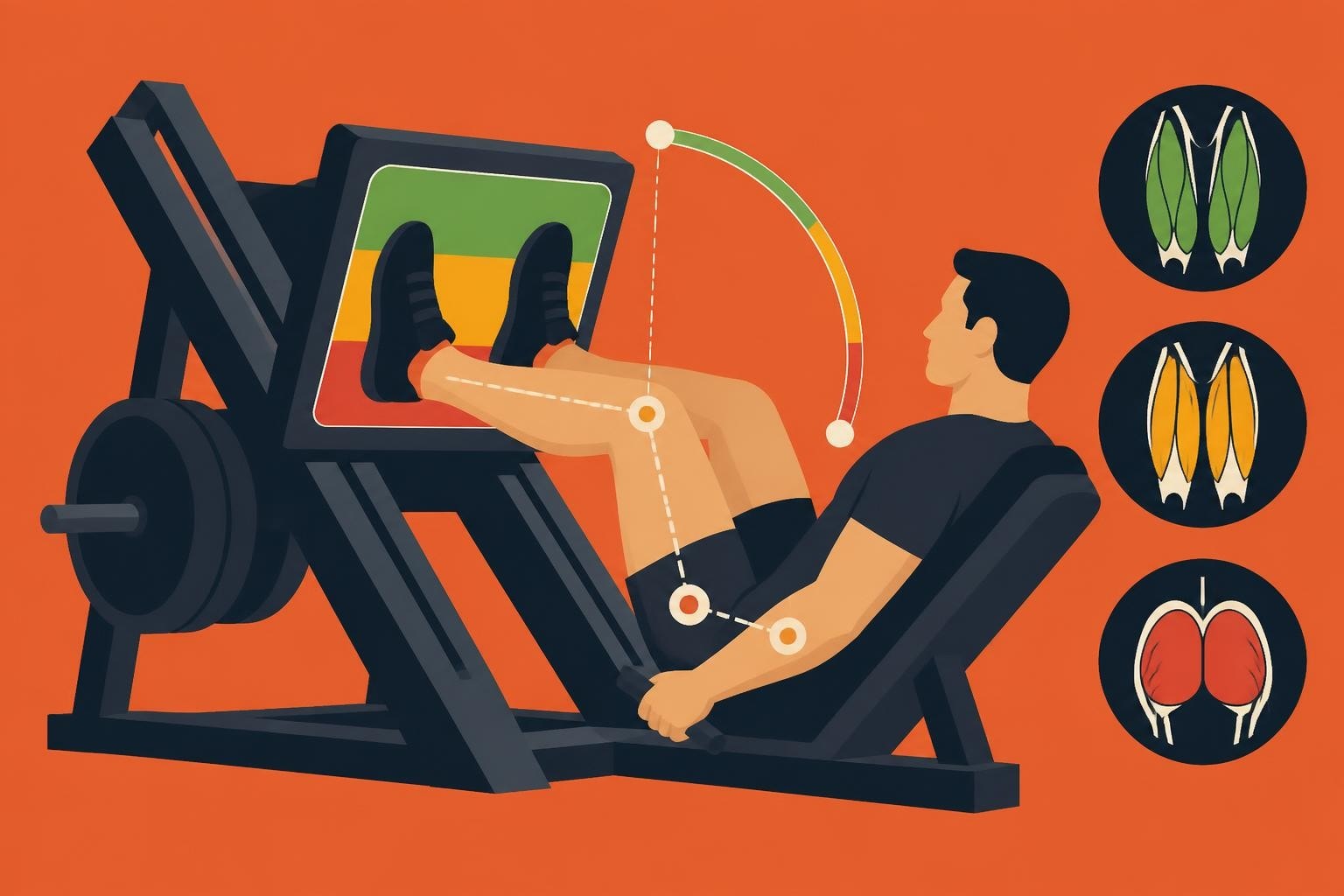
Leg Press: Build Lower Body Strength the Right Way
The leg press is not a shortcut. It is a tool that demands the same discipline and precision as any fundamental movement. Too many men treat it as a machine to pile on plates for show, forgetting that adaptation follows tension, not ego. When executed correctly, this exercise builds serious lower body strength, reinforces movement patterns under load, and provides a stable platform for progressive overload without the technical complexity of barbell work. When done wrong, it becomes a waste of time and a liability to your knees and lower back. The difference is leadership over your own training, not following what you see in a commercial gym.
Understanding the Leg Press as a Training Tool
The leg press serves a specific role in a strength program. It isolates the quadriceps, hamstrings, and glutes while removing spinal loading and balance demands. This makes it valuable for targeted hypertrophy work, rehabilitation protocols, and high-volume training blocks where systemic fatigue must be managed.Research comparing leg press to back squatsshows that while both exercises produce strength gains, the leg press generates significantly less systemic stress and faster recovery times, allowing for higher training frequencies when programmed intelligently.
The machine is not a replacement for compound movements. It is a supplement. The squat remains the foundation of lower body development because it demands full-body coordination, core stability, and motor control. The leg press removes those elements, which means it removes both the difficulty and the complete adaptation. Use it where it belongs: as an accessory to add volume, work around injuries, or focus on specific muscle groups after your primary work is complete.
Machine Variations and Their Applications
Three primary leg press designs exist in most facilities. The 45-degree angled sled is most common, offering a natural movement path and significant loading capacity. The horizontal leg press reduces spinal compression further and works well for older populations or those with back issues. The vertical leg press, less common today, requires strict control but provides unique loading angles. Each has a place depending on your needs, limitations, and training phase.
Key considerations for machine selection:
Angled sled:Best for general strength and hypertrophy work, allows heaviest loads
Horizontal:Ideal for rehabilitation, beginners, or those managing lower back issues
Vertical:Requires advanced body awareness, limited practical advantage for most trainees
Your choice should follow your current training objective and physical constraints, not convenience or what looks impressive. A man recovering from an injury has no business loading a 45-degree sled to match his pre-injury numbers. That is not courage; it is stupidity masquerading as toughness.
Proper Execution and Common Technical Failures
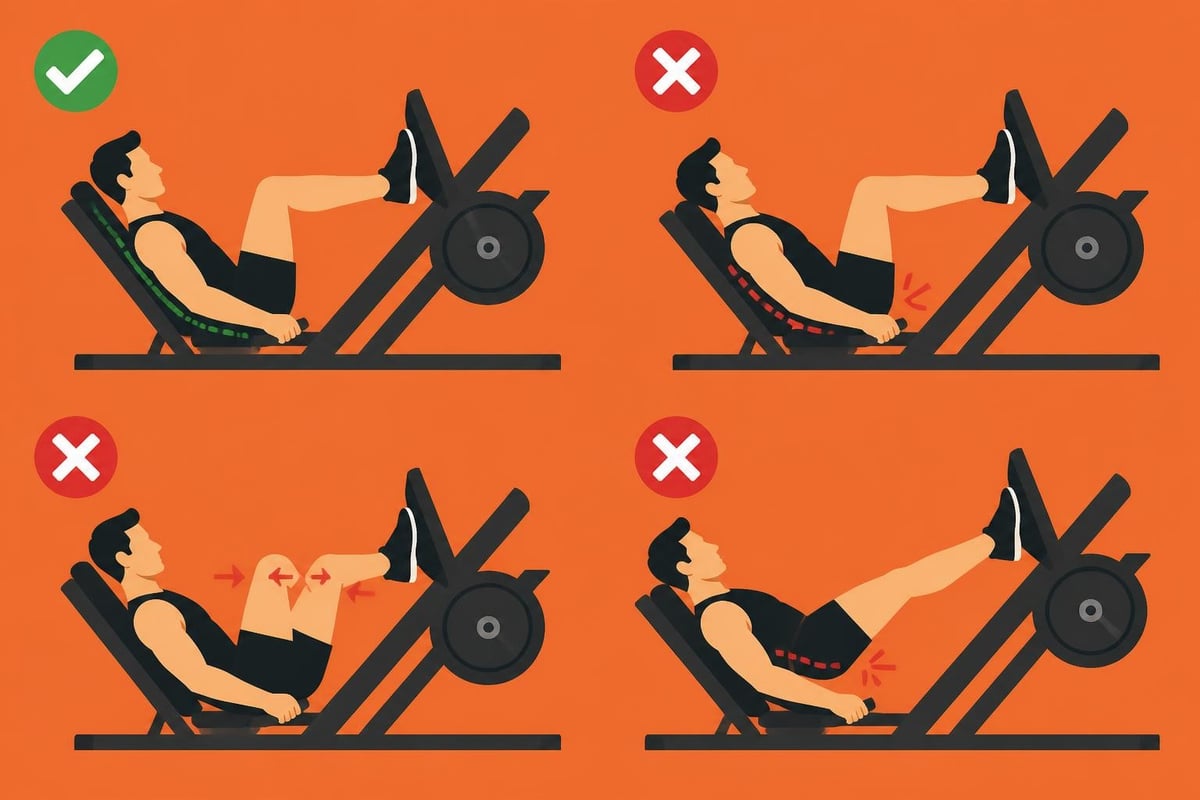
Setup determines everything. Position yourself so your lower back maintains contact with the pad throughout the entire range of motion. Your feet should be placed on the platform with intentionality, not randomly. A mid-platform stance with feet hip-to-shoulder width apart targets all major muscle groups evenly. Moving your feet higher on the platform shifts emphasis to the glutes and hamstrings. Lower placement increases quadriceps recruitment but also increases knee stress, particularly if you have any existing knee issues or poor ankle mobility.
The execution standard is non-negotiable. Lower the sled until your knees reach approximately 90 degrees, maintaining a neutral spine position. Your lower back should never round or lift off the pad. If it does, you have exceeded your functional range of motion and are now loading your lumbar spine in a compromised position. This is where injuries happen, not from heavy weight, but from abandoning position under load.Studies on leg press biomechanics and activation patternsconfirm that maintaining proper spinal alignment throughout the movement is critical for both safety and optimal muscle recruitment.
The Five Non-Negotiable Technical Standards
Lower back contact:Pad contact must be continuous from start to finish
Controlled descent:No bouncing at the bottom, no momentum-driven reversals
Full foot pressure:Weight distributed across entire foot, no heel lifting
Knee tracking:Knees track over toes, no inward collapse or excessive flare
Breathing pattern:Inhale on descent, exhale on drive, never hold breath under max load
These are not suggestions. They are requirements. Every repetition that violates these standards is building a pattern that will eventually cause injury or limit your progress. The weight on the sled means nothing if your execution is compromised.
Programming Strategy for Real Results
The leg press fits into a program based on your training age, recovery capacity, and primary goals. For a father over 35 balancing work, family, and fitness,custom programmingthat accounts for recovery demands is not optional. It is the difference between sustainable progress and burnout. The leg press typically belongs in the second or third exercise slot after your primary compound movement, where you can accumulate volume without the technical and mental demands of heavy squatting.
Volume and intensity must follow a logical progression. Beginners should focus on sets of 8-12 repetitions with controlled tempo and perfect form. This builds the movement pattern and creates the connective tissue adaptations needed to handle heavier loads later. Intermediate trainees can incorporate a wider rep range, using sets of 6-8 for strength emphasis and 12-15 for hypertrophy blocks. Advanced lifters might use the leg press for high-rep pump work, drop sets, or as a fatigue management tool during competition preparation.
Sample leg press programming by training goal:
Training Goal | Sets × Reps | Load (% estimated max) | Frequency per Week | Placement in Workout |
|---|---|---|---|---|
Strength | 4-5 × 6-8 | 75-85% | 1-2 | After primary squat work |
Hypertrophy | 3-4 × 10-12 | 65-75% | 2-3 | Second or third exercise |
Endurance | 2-3 × 15-20 | 50-60% | 2 | Final lower body movement |
Rehabilitation | 2-3 × 12-15 | 40-50% | 2-3 | Primary exercise with restrictions |
Rest periods matter as much as the sets themselves. Strength work demands 2-3 minutes between sets to allow for ATP replenishment and nervous system recovery. Hypertrophy training can use shorter rest periods of 60-90 seconds to maintain metabolic stress. The common mistake is resting too little between heavy sets, turning strength work into conditioning and compromising both objectives.
Foot Placement and Muscle Emphasis
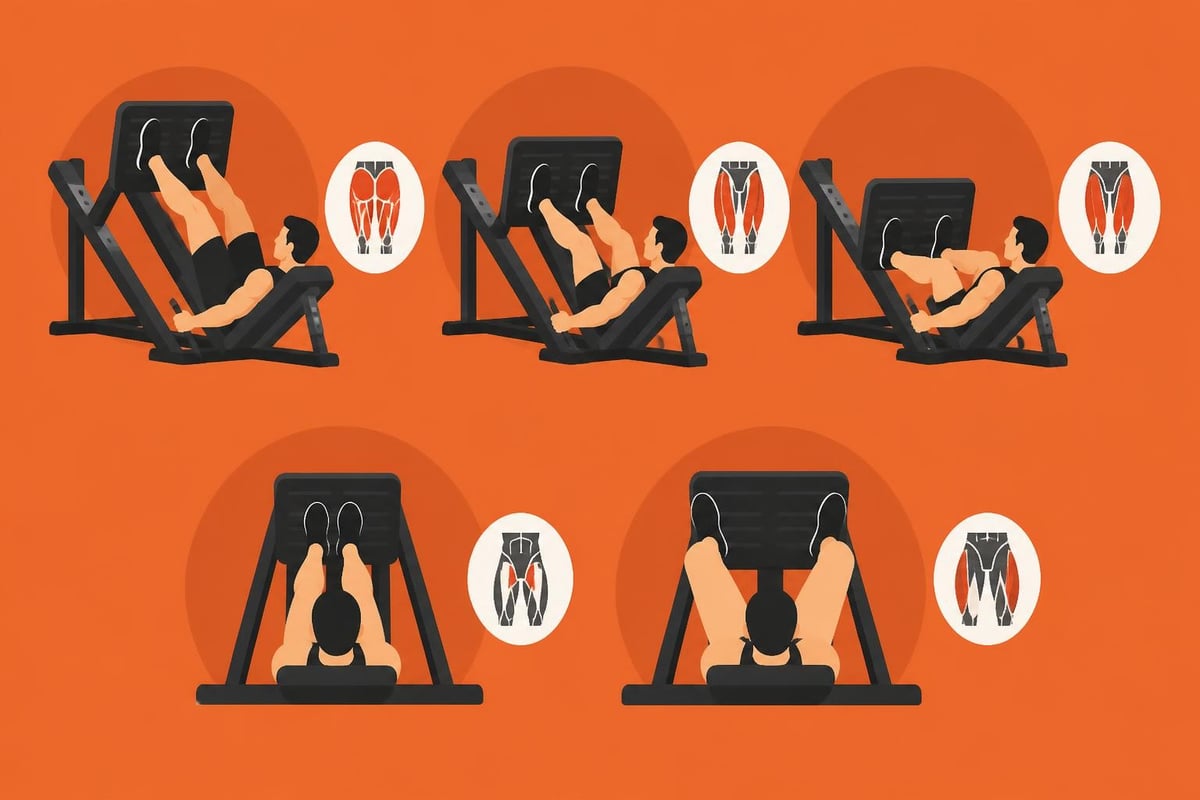
Where you place your feet determines which muscles receive primary loading. This is not minor detail work; it is strategic exercise selection within a single movement. A high foot placement with a wider stance shifts work to the posterior chain, particularly the glutes and hamstrings. This position also reduces knee flexion angle and may be appropriate for those managing knee issues or wanting to emphasize hip extension strength.
Low foot placement increases quadriceps activation significantly but demands greater knee flexion and ankle mobility. If you lack ankle dorsiflexion range, this position will cause your heels to lift or your lower back to round. Neither is acceptable. Fix your mobility limitation before attempting this variation, or choose a foot position that matches your current capabilities.
Muscle emphasis by foot position:
High and wide:Glutes, hamstrings, inner thigh (adductors)
Middle and shoulder-width:Balanced quadriceps, hamstrings, glutes
Low and narrow:Quadriceps (vastus medialis emphasis)
Toes pointed out:Increased adductor recruitment
Toes neutral:Balanced lower body activation
Changing foot position within a workout is a viable strategy for complete leg development, but it requires reducing load appropriately. You cannot maintain the same weight across all positions and expect quality execution. Drop the load 15-20% when changing positions and rebuild from there.
Recovery Protocols and Injury Prevention
The leg press produces significant muscle damage and metabolic waste, particularly when used for high-volume work.Research on recovery demands after leg press trainingshows that proper post-training protocols significantly impact your ability to train with intensity again within 48-72 hours. Neglecting recovery is not toughness; it is poor planning that leads to accumulated fatigue, performance decline, and eventual injury.
Active recovery strategies should include targeted mobility work for the hips, knees, and ankles within 12-24 hours post-training. Light walking, cycling, or bodyweight movements help clear metabolic waste without adding mechanical stress. For men over 35, this recovery work is not optional if you want to maintain training frequency and intensity week after week. Your body's recovery capacity has changed. Your training approach must change with it.
Post-workout recovery can be enhanced through evidence-based strategies including contrast therapy and magnesium supplementation. Many fathers find that alternating between heat and cold exposure, such as sauna followed by cold plunge, accelerates recovery from intense leg training.Quality sauna equipmentdesigned for home use makes this protocol sustainable long-term, and topicalmagnesium-based recovery productscan address muscle soreness and sleep quality without pharmaceutical intervention.
Warning Signs That Demand Immediate Action
Your body communicates clearly when something is wrong. Ignoring these signals is not mental toughness; it is negligence. Sharp pain during or after the movement, particularly in the knee or lower back, requires immediate evaluation. Persistent soreness that does not resolve within 72 hours indicates either overtraining or improper execution. Numbness, tingling, or radiating pain suggests nerve involvement and demands professional assessment before continuing training.
Red flags requiring immediate modification or cessation:
Sharp pain in knee joint during movement
Lower back pain that worsens with training frequency
Knee instability or "giving way" sensation
Pain that increases rather than decreases with warm-up
Numbness or tingling in legs or feet during or after exercise
When these occur, your responsibility is not to push through. It is to identify the root cause and address it systematically.Rehabilitation protocols for knee proceduresshow that the leg press can be safely reintroduced after injury when loading, range of motion, and volume are controlled appropriately, but only when medical clearance has been obtained and progression follows clinical guidelines.
Advanced Techniques and Their Applications
Once fundamental execution is mastered, advanced methods can accelerate progress. Tempo manipulation changes time under tension and metabolic demand. A 4-0-1-0 tempo (four-second eccentric, no pause, one-second concentric, no rest) dramatically increases hypertrophy stimulus compared to standard lifting speed. This is not random variation; it is targeted application of a known adaptation principle.
Accentuated eccentric loading researchdemonstrates that emphasizing the lowering phase of the leg press can produce superior strength and size gains compared to traditional training. This requires either manual loading adjustments or specialized equipment, but the principle can be applied simply by using a slower eccentric tempo with your current working weight.
Proven Advanced Methods for Experienced Lifters
Method | Application | Recovery Cost | Best Used For |
|---|---|---|---|
Drop Sets | 3-4 drops of 20-25% after failure | High | Hypertrophy, breaking plateaus |
Pause Reps | 2-3 second pause at bottom | Moderate | Strength, eliminating momentum |
1.5 Reps | Full rep plus half rep counted as one | Moderate | Time under tension, work capacity |
Eccentric Emphasis | 4-6 second lowering phase | High | Strength, muscle damage stimulus |
Cluster Sets | Short rest (10-15 sec) between mini-sets | Moderate | Strength-endurance, volume accumulation |
These techniques serve specific purposes and should be programmed intentionally, not applied randomly because you are bored. Each carries a recovery cost. Using multiple advanced methods simultaneously or too frequently will exceed your recovery capacity and stall progress. Choose one method, apply it for 3-4 weeks, assess results, then modify or remove it.
Integration with Compound Movements
The leg press does not exist in isolation. Its value is determined by how it fits within your complete lower body training. For most men, the squat or deadlift should be your first movement of the day when neural drive and motivation are highest. The leg press follows as an accessory to add volume to specific muscle groups without the same systemic fatigue cost.
A practical weekly structure might include heavy squats on Monday, followed by moderate-volume leg press work. Thursday could feature deadlifts with lighter, higher-rep leg press assistance targeting the quadriceps specifically. This separation allows adequate recovery between heavy loading sessions while maintaining training frequency for muscle growth. The specific split matters less than the principle: primary compound work first, accessory leg press work second, adequate recovery between sessions.
Some training phases may prioritize the leg press more heavily. During injury rehabilitation, when working around a shoulder issue that limits squatting, or when managing accumulated fatigue from other life stress, the leg press can temporarily serve as your primary lower body movement.Clinical guidelines for post-surgical rehabilitationoften incorporate the leg press as a primary strengthening tool because it provides controllable loading without balance demands or spinal compression.
Load Selection and Progressive Overload
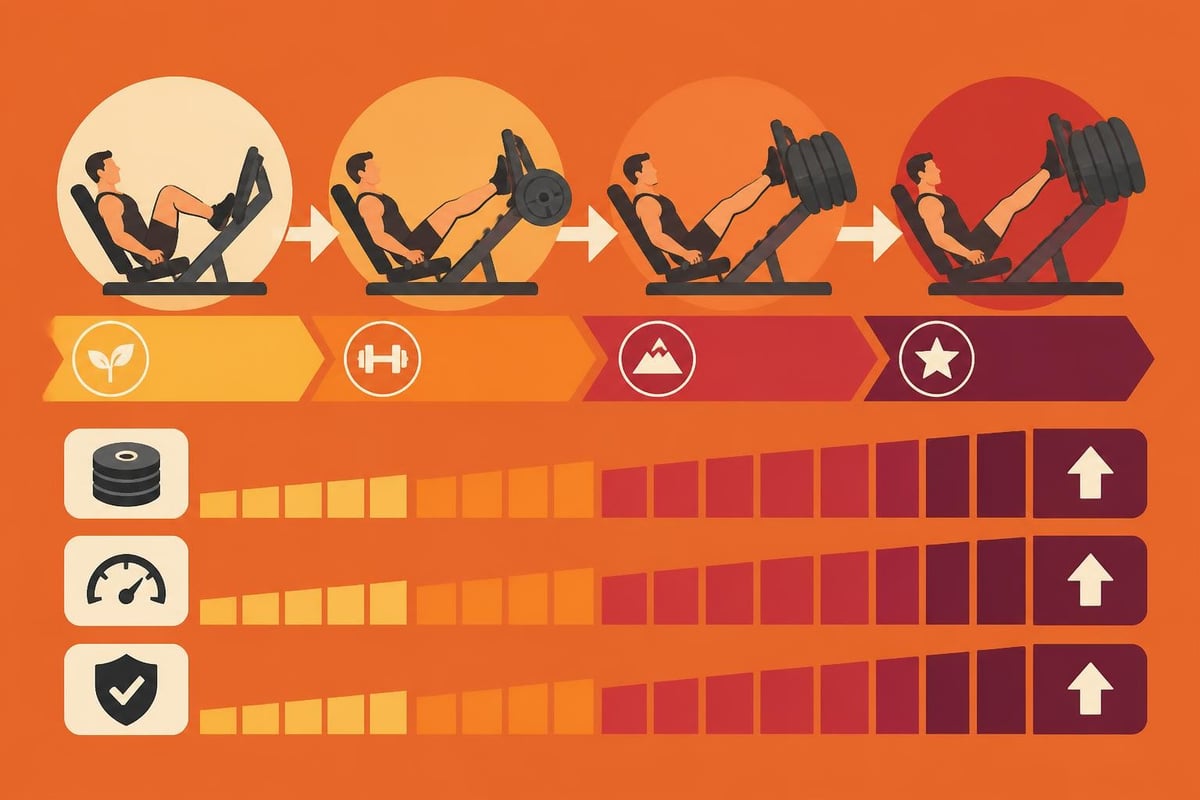
Starting weight should allow for perfect execution across all prescribed repetitions with two to three reps remaining in reserve. This is not sandbagging; it is establishing a baseline from which to progress systematically. Too many men start too heavy, compromise form from repetition one, and wonder why they are not growing or why their knees hurt after three weeks.
Progressive overload must be planned, not random. The simplest approach is adding 5-10 pounds per session when all sets and reps are completed with proper form. When you can no longer add weight session-to-session, add one repetition to each set until you reach the top of your rep range, then increase load and drop back to the bottom of the range. This is basic periodization that works for decades because it respects adaptation timelines and recovery capacity.
Progressive overload decision matrix:
All sets completed with 2+ reps in reserve:Add 5-10 lbs next session
All sets completed with 0-1 reps in reserve:Repeat same weight, focus on execution quality
Failed to complete final set:Reduce load 10%, rebuild over 2-3 weeks
Form breakdown on any set:Reduce load immediately, do not continue set
Tracking your training is not optional if you want continued progress. Whether you use a notebook, spreadsheet, or app matters far less than the consistency of recording sets, reps, and load. Without data, you are guessing. With data, you can identify patterns, address sticking points, and make informed decisions about when to push and when to back off.
Application for Fathers Over 35
Your training at 35 and beyond requires different management than it did at 25. Recovery capacity has decreased. Injury history has accumulated. Life stress from work and family is higher. These are facts, not excuses. The leg press becomes more valuable in this context because it allows you to train hard without the cumulative stress of heavy bilateral squatting multiple times per week.
A father managing a full-time career, marriage, and active parenting cannot train like a 22-year-old college athlete. The volume and frequency must fit your life, not fight it. Two focused leg sessions per week, each including one primary compound movement and leg press assistance work, produces excellent results when executed consistently over months and years. Consistency beats intensity every time in the long game.
TheGroup Coaching Communityat The Father Forge exists specifically for this reason: fathers over 35 need structure, accountability, and programming that accounts for their complete life context, not just their gym performance. Brotherhood and weekly coaching calls create the environment where sustainable progress happens, where you are held to standards by men who understand your obligations and constraints.
Common Mistakes and Immediate Corrections
Bouncing at the bottom of the movement is the most common and most dangerous error. This creates massive shear forces across the knee joint and turns a controlled strength exercise into a ballistic event your connective tissue is not designed to handle. The fix is simple: pause for one full second at the bottom of each repetition. This eliminates momentum completely and forces you to reduce the weight to a level you can actually control.
Partial range of motion is equally problematic. Lowering the sled six inches and calling it a repetition builds nothing except ego. Full range of motion, defined as lowering until your knees reach 90 degrees while maintaining spinal position, is the minimum standard. If you cannot achieve this, you have a mobility limitation or you are using too much weight. Address the root cause, not the symptom.
Allowing your knees to cave inward during the press indicates weak hip abductors and poor motor control. This valgus collapse increases ACL stress and reduces force production. The immediate correction is reducing load by 30-40% and focusing on driving your knees outward throughout the entire movement. This is not a weight problem; it is a movement quality problem that requires conscious correction until the pattern is relearned.
The leg press is a tool that serves men who understand training as a long-term investment in capacity, not a short-term demonstration of ego. Executed with discipline and programmed intelligently, it builds lower body strength, supports muscle growth, and provides a training option when other movements are limited by injury or fatigue. The difference between effective use and wasted effort is leadership over your own standards and accountability to execution quality. If you need structure, programming, and brotherhood to make consistent progress while managing the demands of fatherhood and career,The Father Forgeprovides exactly that: custom training built for your complete life, not just your gym performance.