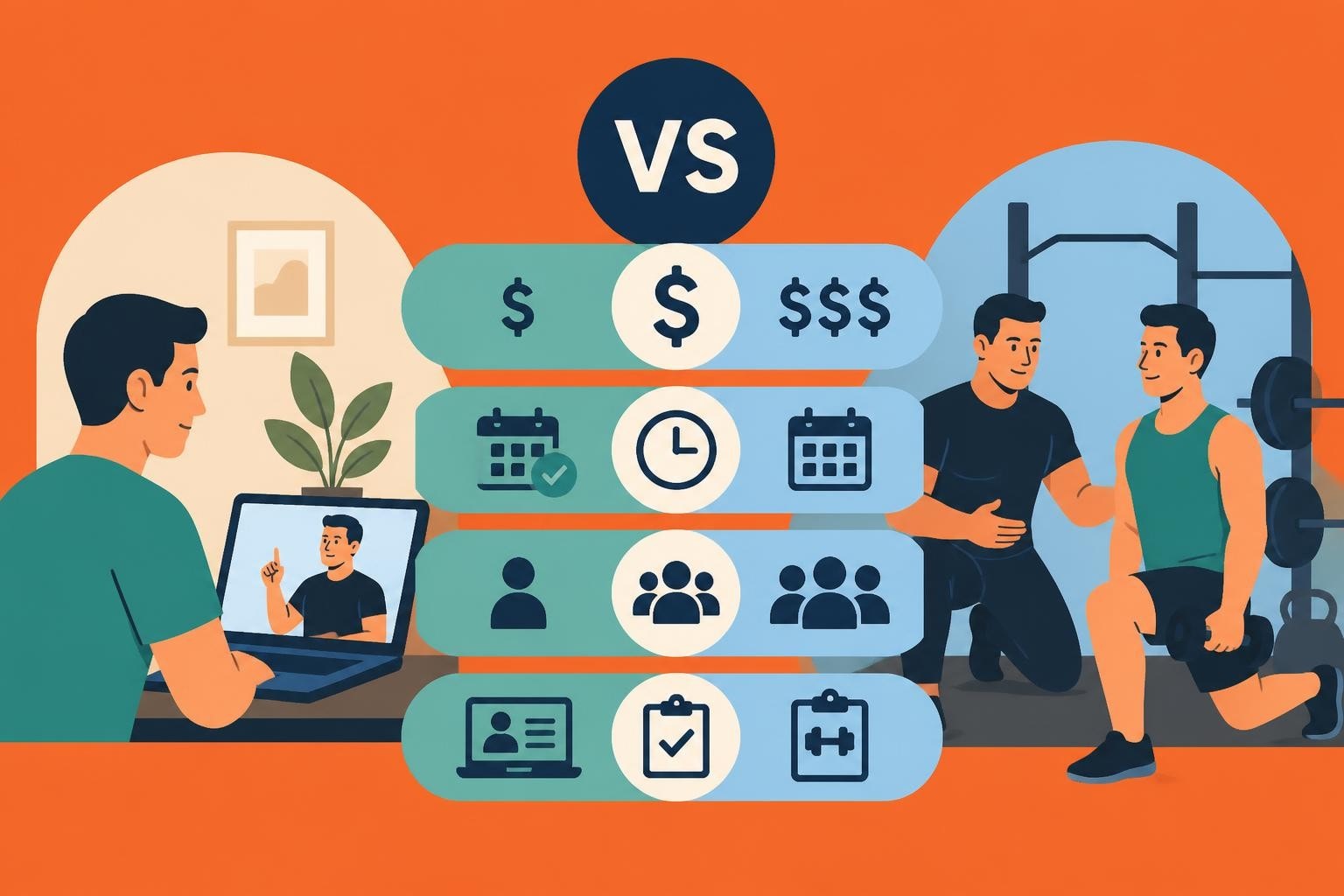
Gym Professional Trainer: Online vs In-Person Coaching
Choosing between an online gym professional trainer and an in-person gym professional trainer is not about finding information. You already know both options exist. The real decision is about which environment creates accountability, delivers measurable results, and respects your obligations as a man with limited time and resources. Most men waste months bouncing between options because they mistake preference for principle. This comparison cuts through the noise and shows you which model serves your mission better.
The Cost Reality: What You Actually Pay
The price difference between online and in-person training is not just about dollars. It's about what you receive for those dollars and whether the investment compounds or evaporates.
In-Person Training Costs
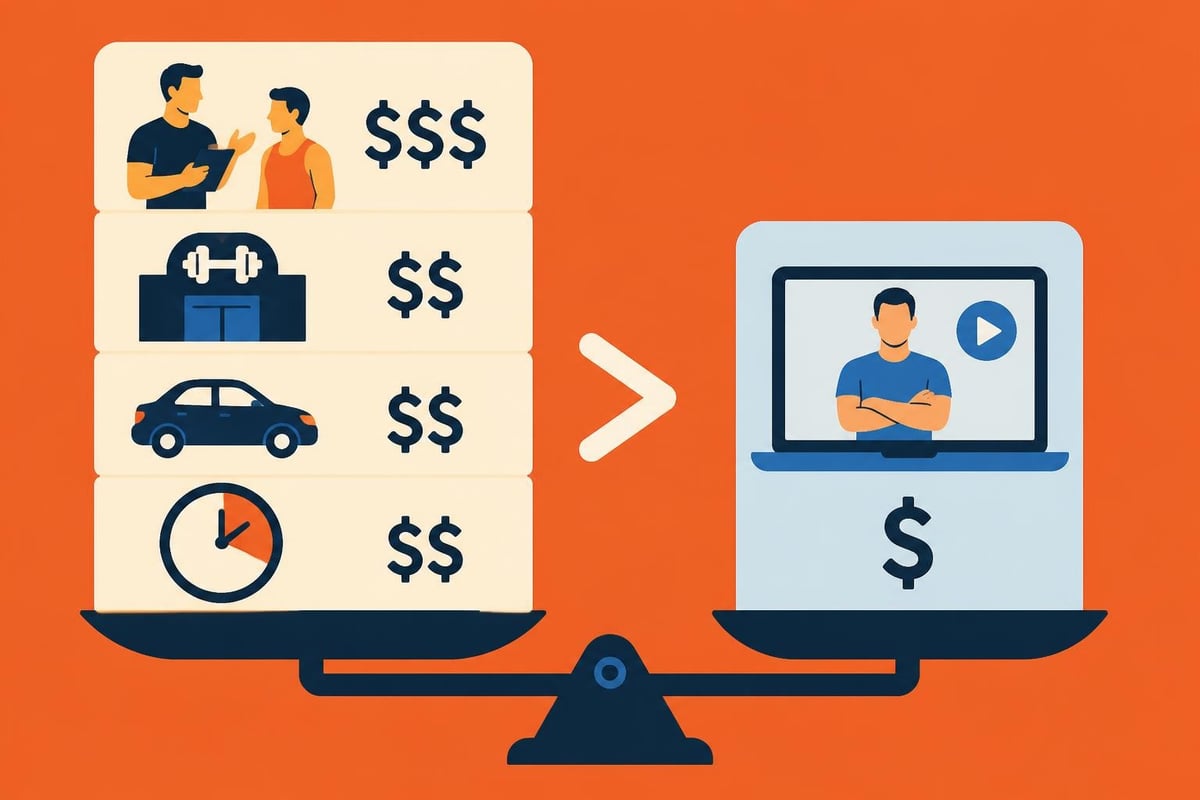
A gym professional trainer working in a commercial facility charges between $60 and $150 per hour in most American markets. Premium trainers in major cities push $200 per session. Train three times weekly and you're spending $720 to $1,800 monthly. That's before gym membership fees, which add another $50 to $200 depending on the facility.
The hidden costs stack higher:
Commute time (30-60 minutes roundtrip per session)
Fuel or public transportation
Parking fees in urban areas
Time away from family obligations
Childcare if training during non-work hours
Calculate the full cost and most men discover they're spending $1,000 to $2,500 monthly when all factors are included. That's not sustainable for most fathers managing household budgets and family priorities.
Online Training Investment
An online gym professional trainer typically charges $200 to $600 monthly for comprehensive programming. This includes customized workout plans, nutrition guidance, regular check-ins, and ongoing adjustments based on progress. Some premium coaches reach $800 to $1,200 for intensive one-on-one support, but you're still spending less than half of in-person costs.
Cost FactorIn-Person TrainingOnline TrainingBase monthly fee (3x/week)$720 - $1,800$200 - $600Gym membership$50 - $200$0 - $50 (optional)Transportation$80 - $200$0Time cost (commute)6-12 hours/month0 hoursTotal monthly investment$850 - $2,200$200 - $650
The math is clear. Online training delivers professional programming at one-quarter to one-third the total cost. The Father Forge's1-on-1 Men's Coachingprovides exactly this model, combining personalized fitness programming with accountability structures designed for men who lead families.
Programming Quality: Customization vs Cookie-Cutter
The assumption that in-person training automatically means better programming is false. Quality depends on the trainer's knowledge, commitment to individualization, and systems for tracking progress.
In-Person Programming Limitations
Most commercial gym professional trainers follow templates. They modify basic programs slightly based on your goals, but the core structure remains generic. Why? Time constraints. When a trainer sees 20-30 clients weekly, individual program design becomes unsustainable. They rely on proven frameworks and adjust variables like sets, reps, and exercise selection.
This approach works for beginners. It fails for men with specific demands: fathers with irregular schedules, men managing old injuries, leaders who need programs that adapt to high-stress weeks. TheNational Strength and Conditioning Associationemphasizes individualized programming as the foundation of effective training, yet most commercial trainers cannot deliver this consistently.
In-person sessions also create performance pressure. You show up, execute the prescribed workout, and leave. There's limited time to discuss nutrition struggles, sleep issues, or how stress is affecting recovery. The focus stays narrow: complete the hour, maintain intensity, repeat next session.
Online Programming Advantages
A dedicated online gym professional trainer builds programs around your complete schedule, environment, and constraints. They assess your available equipment, training time windows, recovery capacity, and competing obligations. The program adapts to you, not the other way around.
Key programming benefits:
Programs designed for home gyms, commercial facilities, or minimal equipment
Adjustments made between sessions based on feedback, not just during sessions
Integration of mobility work, conditioning, and strength in coordinated phases
Nutritional guidance that accounts for family meals and real-world eating
Recovery protocols that fit actual sleep patterns and stress loads
The asynchronous communication model lets you document struggles, ask questions when they arise, and receive detailed responses. A quality online coach reviews your form videos, analyzes your reported performance, and modifies programming based on comprehensive data. This beats the snapshot view an in-person trainer gets during isolated sessions.
Research fromHarvard Healthconfirms that the trainer-client relationship and consistent accountability matter more than physical proximity. Online platforms enable more frequent touchpoints through app-based check-ins, video reviews, and message threads.
Accountability Structures: Presence vs Process
The belief that in-person training creates superior accountability is backwards. Presence creates temporary compliance. Process creates lasting responsibility.
In-Person Accountability Model
When you pay a gym professional trainer for in-person sessions, accountability exists during that hour. The trainer watches your form, counts your reps, pushes your intensity. This external accountability has value for men who lack self-discipline or training knowledge.
The problem surfaces between sessions. What happens on the four or five days you train alone? Most in-person clients receive basic guidance: do this workout on Tuesday, that one on Friday. But there's no system ensuring execution, no feedback loop confirming progression, no structure holding you responsible for the work that determines 70% of your results.
In-person training also enables excuse-making. Missed a session? Reschedule. Didn't follow the nutrition plan? Discuss it next week. The relationship can become transactional rather than transformational because consequences remain abstract.
Online Accountability Systems
A professional online gym professional trainer builds accountability into the entire week, not just training sessions. Daily or weekly check-ins become non-negotiable. You report workouts, nutrition adherence, sleep quality, and stress levels. The coach reviews this data and responds with adjustments or challenges.
This model forces ownership. There's no trainer standing over you during the workout. You execute the program because you committed to it and because someone is reviewing your reported results. This builds internal accountability, the kind that lasts after the coaching relationship ends.
Online accountability mechanisms:
Weekly progress photos and measurements
Training log submissions with performance data
Nutrition tracking through apps with coach access
Regular video form checks with detailed feedback
Scheduled calls or voice messages for complex issues
Community accountability through group coaching elements
TheNASM Resource Centerprovides extensive continuing education on accountability strategies, and the most effective approaches emphasize systems over supervision. Men respond to structure and clear expectations, not just motivation and presence.
Schedule Flexibility: Fixed Slots vs Adaptive Training
Your schedule as a father and leader is not predictable. Work demands shift. Kids get sick. Emergency obligations arise. Training must adapt to this reality or it becomes another source of stress.
In-Person Schedule Constraints
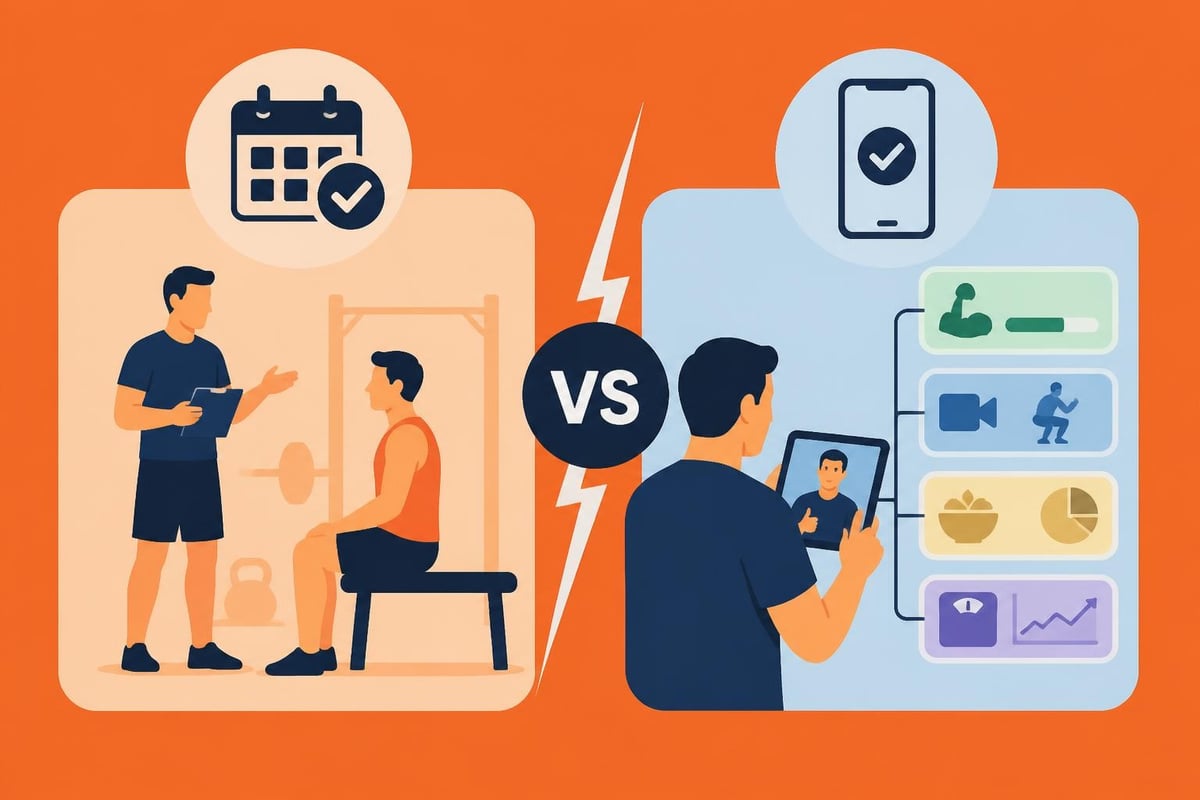
A gym professional trainer working in-person operates on fixed appointment slots. You book specific times, usually the same days and hours each week. This creates rigid structure that conflicts with dynamic family and work responsibilities.
Miss a session and you've wasted that time slot and your money. Reschedule and you disrupt both your schedule and the trainer's. The system punishes unpredictability, which means it punishes normal life for most men with families.
Training times also compete with family obligations. Early morning sessions mean less time with kids before school. Evening sessions cut into family dinner and bedtime routines. The in-person model forces you to choose between training consistency and family presence.
Online Flexibility Advantages
An online gym professional trainer designs programs that flex around your available windows. Train at 5 AM Monday, 9 PM Tuesday, and noon Saturday. The program doesn't care when you execute it, only that you do.
This flexibility extends to workout structure. Can't complete the full session because your daughter got sick? Your online coach adjusts the remaining week to maintain progression despite the missed volume. Travel for work? Receive a modified hotel gym or bodyweight program before you leave.
The adaptive nature of online coaching means training serves your life rather than ruling it. You maintain consistency through flexibility, not rigid scheduling. This approach aligns with the principles emphasized byStrength Zone Training, where intelligent program design accommodates real-world constraints without sacrificing results.
Knowledge Transfer: Dependency vs Education
The ultimate goal of working with a gym professional trainer should be developing your own training competency. Some models build dependency. Others build capability.
In-Person Dependency Patterns
Commercial gym trainers have a business incentive to keep you dependent. The longer you need them, the longer you pay. This doesn't mean they deliberately withhold knowledge, but the system doesn't reward client independence.
In-person training focuses on execution: do this exercise, use this weight, complete these reps. Educational components exist but remain secondary to getting through the workout. You learn movements but not programming principles. You follow plans but don't understand the logic behind periodization, recovery, or progression strategies.
After months or years with an in-person trainer, most clients still can't design effective programs for themselves. They've learned how to squat and deadlift but not why specific rep ranges matter for different goals or how to manipulate training variables when progress stalls.
Online Education Integration
Quality online gym professional trainers embed education into the coaching process. Written programs include explanations of exercise selection, programming rationale, and progression logic. Check-ins involve teaching moments where the coach explains why adjustments are made.
This educational approach serves the client's long-term development. You learn:
How to modify exercises based on available equipment
When to push through fatigue and when to back off
How nutrition timing affects performance and recovery
Why certain training phases emphasize different qualities
How to recognize and address technique breakdown
The goal is independence. A professional online coach wants you to outgrow basic programming needs and either progress to more advanced coaching or successfully self-program. This aligns incentives correctly: the coach succeeds when the client develops genuine competency.
Resources fromDrew Baye's High Intensity Trainingdemonstrate how education-focused coaching creates lasting client transformation. Men who understand training principles don't just follow programs. They adapt, troubleshoot, and continue progressing independently.
Results Comparison: Environment vs Execution
Results come from consistent execution of effective programming with appropriate nutrition and recovery. The training environment matters less than whether the complete system supports these factors.
In-Person Results Factors
In-person training creates strong workout performance. The trainer ensures you use proper form, push appropriate intensity, and complete prescribed volume. This drives acute training stimulus effectively.
Where in-person training often fails is the other 165 hours of the week. Nutrition remains inconsistent because there's limited coaching around meal planning, grocery shopping, or managing family food dynamics. Sleep suffers because there's no accountability for recovery protocols. Stress management gets lip service but no systematic intervention.
The result is solid gym performance with suboptimal lifestyle support. Men make modest progress but plateau because training is only one variable in a multi-factor equation.
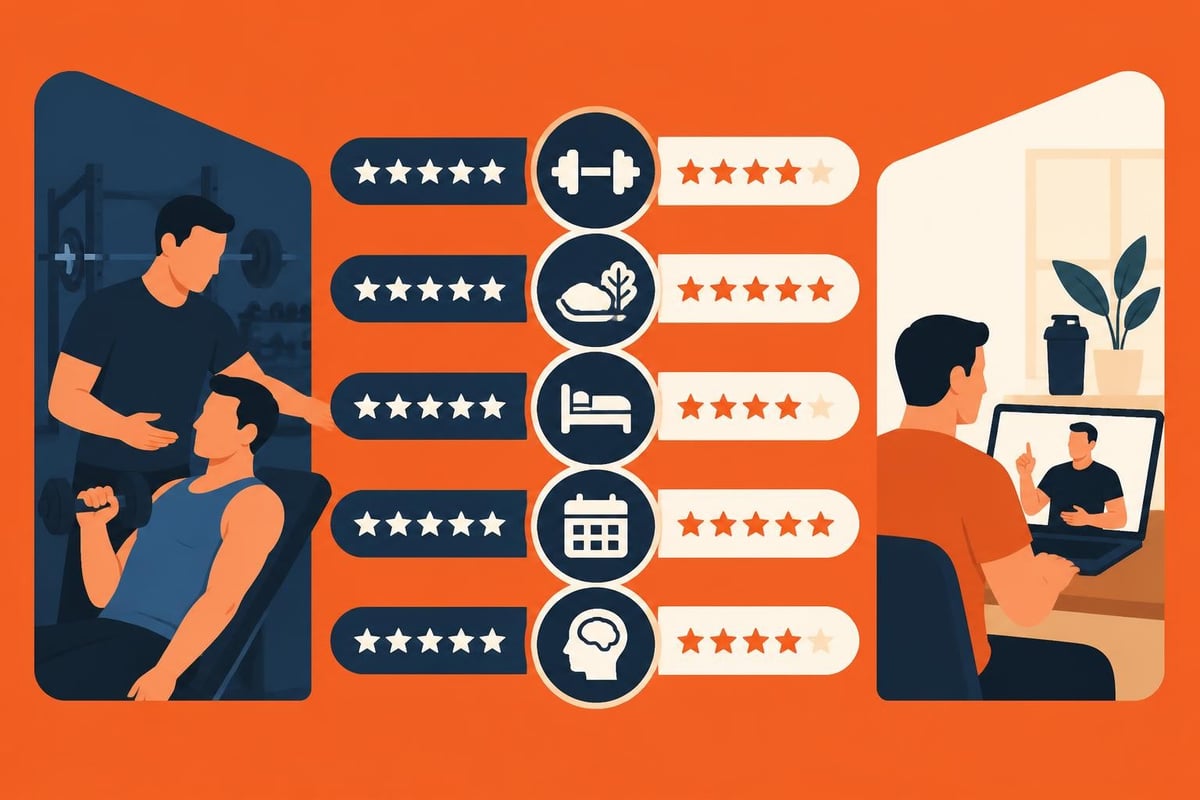
Success FactorIn-Person TrainingOnline CoachingWorkout execution qualityExcellentGood to ExcellentNutrition adherenceFair to GoodGood to ExcellentRecovery optimizationFairGood to ExcellentStress managementPoor to FairGoodConsistency (sessions/month)12-1616-20Long-term sustainabilityModerateHighKnowledge developmentLow to ModerateModerate to High
Online Results Reality
Online coaching produces results through comprehensive lifestyle integration. Your gym professional trainer tracks training, nutrition, sleep, and stress as interconnected variables. Adjustments address the complete picture, not just exercise selection.
Men working with dedicated online coaches report higher training frequency because flexibility enables more consistent execution. They develop better nutritional habits because coaching addresses real-world challenges like family meals and work travel. Recovery improves because the coach monitors and adjusts based on reported fatigue.
TheNSCA's educational resourcesconfirm that comprehensive coaching approaches outperform training-only interventions for body composition and performance outcomes. Men need integrated solutions, not isolated workout sessions.
The Community Factor: Isolation vs Brotherhood
Training alone creates physical development. Training within a brotherhood creates identity transformation.
In-Person Social Limitations
Commercial gyms offer social interaction, but it's superficial. You might exchange pleasantries with other members or build rapport with your trainer, but there's no systematic community structure. Everyone pursues individual goals in shared space.
Some in-person trainers offer small group training, which creates basic camaraderie. This improves on individual sessions but remains limited to the people in your specific time slot at your specific location. The community is accidental, not intentional.
Online Community Advantages
Professional online gym professional trainers often build intentional communities of men pursuing similar transformations. These groups provide accountability, shared experience, and collective problem-solving that far exceeds what random gym interactions offer.
Brotherhood develops when men face similar challenges: balancing training with fatherhood, managing work stress while pursuing fitness goals, navigating marriage while investing in self-improvement. Online communities of purpose-driven men create peer accountability that reinforces coaching interventions.
Community benefits unique to online models:
Access to men across geographic boundaries with shared values
Asynchronous support available when challenges arise, not just during scheduled sessions
Collective wisdom from men at different stages of similar journeys
Accountability that extends beyond trainer relationships into peer networks
Shared resources, strategies, and solutions crowd-sourced from group experience
The Father Forge demonstrates this approach through itsGroup Coaching Community, where fathers over 35 access weekly calls, brotherhood accountability, and structured community support. This model recognizes that transformation happens in relationship with other men committed to the same standards.
Making the Decision: What Your Mission Requires
The choice between an in-person gym professional trainer and an online gym professional trainer is not about which option is universally superior. It's about which model serves your specific mission, constraints, and development stage.
Choose in-person training if:
You have zero training experience and need hands-on movement teaching
Your schedule is completely predictable with fixed available training times
You lack self-discipline and require external supervision to execute workouts
Cost is not a limiting factor in your fitness investment
You have no family or work obligations that create scheduling unpredictability
Choose online coaching if:
You want comprehensive lifestyle coaching beyond just workout supervision
You need schedule flexibility to balance training with family leadership
You value cost efficiency and want maximum return on coaching investment
You're ready to develop self-accountability and training knowledge
You recognize that transformation requires more than gym performance
Most men reading this fall into the second category. You're not beginners. You're fathers, leaders, men with competing obligations who need systems that work with your life, not against it. You want results, but you also want to maintain your role as present fathers and engaged husbands.
For men in this position, online coaching with a dedicated gym professional trainer delivers superior outcomes. The cost efficiency alone makes it sustainable long-term. The schedule flexibility enables consistency despite unpredictable demands. The comprehensive approach addresses the complete transformation, not just physical training.
Resources likeFitnessCalcsprovide evidence-based tools supporting the online coaching model, demonstrating that technology-enabled training matches or exceeds in-person outcomes when properly implemented. The data supports what practical experience confirms: online coaching works for men who commit to the process.
Investment vs Expense: Long-Term Thinking
The difference between investment and expense is whether spending creates compounding returns or temporary results. This distinction separates men who transform from men who spin in place.
A gym professional trainer charging $150 per session becomes an expense if you train for six months, make modest gains, then quit because the cost is unsustainable. You spent $10,800 for temporary improvement that evaporates when the sessions end.
An online coach charging $500 monthly becomes an investment when you develop training knowledge, establish sustainable habits, build self-accountability, and create systems that persist after coaching ends. You spent $3,000 over six months and received tools that compound for years.
The in-person model emphasizes service delivery: you receive training sessions. The online model emphasizes capability building: you develop into a man who knows how to train, eat, recover, and adapt programs to changing circumstances.
Think like a leader making resource allocation decisions. What spending creates lasting capability? What creates dependency? What builds systems that persist? What requires ongoing support to maintain?
Men who understand investment thinking choose models that build capacity, not just deliver services. They recognize that paying less for better long-term outcomes is not compromise, it's strategic thinking.
The Technology Advantage: Tools That Enable Results
Online coaching leverages technology to create capabilities impossible in traditional in-person training. This is not about gadgets. It's about tools that enable better programming, tracking, and accountability.
Programming and Tracking Tools
Online gym professional trainers use software platforms that track every workout, measure progressive overload, analyze volume and intensity trends, and flag recovery issues. You receive programs that adapt based on logged performance, not just weekly conversations.
Form check videos submitted between sessions let your coach review technique when it matters, during actual training. This beats periodic in-session form corrections because the feedback addresses real execution under fatigue, not demonstration reps while fresh.
Nutrition tracking apps with coach integration create transparency impossible with in-person models. Your coach sees actual eating patterns, not self-reported estimates. Adjustments address documented behavior, not assumptions.
Communication and Accessibility
Text, voice messages, and video updates enable real-time problem-solving. Question about exercise substitution because your gym is crowded? Message your coach and receive guidance within hours. Struggling with nutrition adherence during work travel? Share the challenge and receive modified strategies immediately.
This asynchronous communication often provides better support than scheduled in-person sessions. You get help when problems arise, not during the next appointment slot days later. The response quality improves because coaches can research, consider, and provide detailed written guidance rather than immediate verbal responses.
Platforms featured on sites likeEric Broser's coaching resourcesdemonstrate how technology-enabled programming creates superior customization and tracking compared to clipboard-and-pen in-person methods.
The Mentorship Model: Coaching That Builds Leaders
The highest value a gym professional trainer provides is not exercise instruction. It's mentorship that develops your capacity for self-leadership, discipline under pressure, and commitment to standards when convenient excuses are available.
In-person training relationships rarely evolve into true mentorship. The transactional nature, time constraints, and focus on workout execution limit deeper development. You receive good training, not life integration.
Online coaching with the right professional creates space for mentorship. The communication model enables deeper conversation about obstacles, mindset challenges, and the integration of training into leadership development. You discuss not just how to train, but why you're training and what you're building through the discipline.
For fathers specifically, this distinction matters. Training is not separate from fatherhood. It's part of modeling discipline, commitment, and self-improvement for your children. The right gym professional trainer helps you integrate these elements rather than compartmentalize fitness as something you do apart from family.
The Father Forgeoperates from this understanding. Training, mindset work, and family leadership are interconnected. Programs develop physical capacity while building the mental resilience and emotional balance that make you a better father and husband. This integrated approach requires the comprehensive communication and personalized attention that online coaching enables.
Choosing between online and in-person training comes down to what you actually need versus what you assume you need. Most men discover that online coaching with a dedicated gym professional trainer delivers better results at lower cost with greater flexibility and more comprehensive support. If you're ready for customized programming that fits your life as a father and leader,The Father Forgeprovides exactly that: fitness and mindset coaching built for men who lead at home and refuse to settle for generic solutions.