AB Workouts: Build Core Strength That Lasts
Most men treat ab workouts like a daily penance for last night's dinner. They chase the burn, stack up hundreds of crunches, and wonder why their midsection never changes. The problem isn't effort. It's direction. Your core is a stability system, not a show muscle. Train it that way, and everything from your deadlift to your posture at the dinner table improves. Ignore that truth, and you'll spend years doing sit-ups with nothing to show but a sore neck. This is about building functional strength that serves your mission as a father and leader, not chasing Instagram abs that dissolve the moment life gets hard.
What Ab Workouts Actually Do
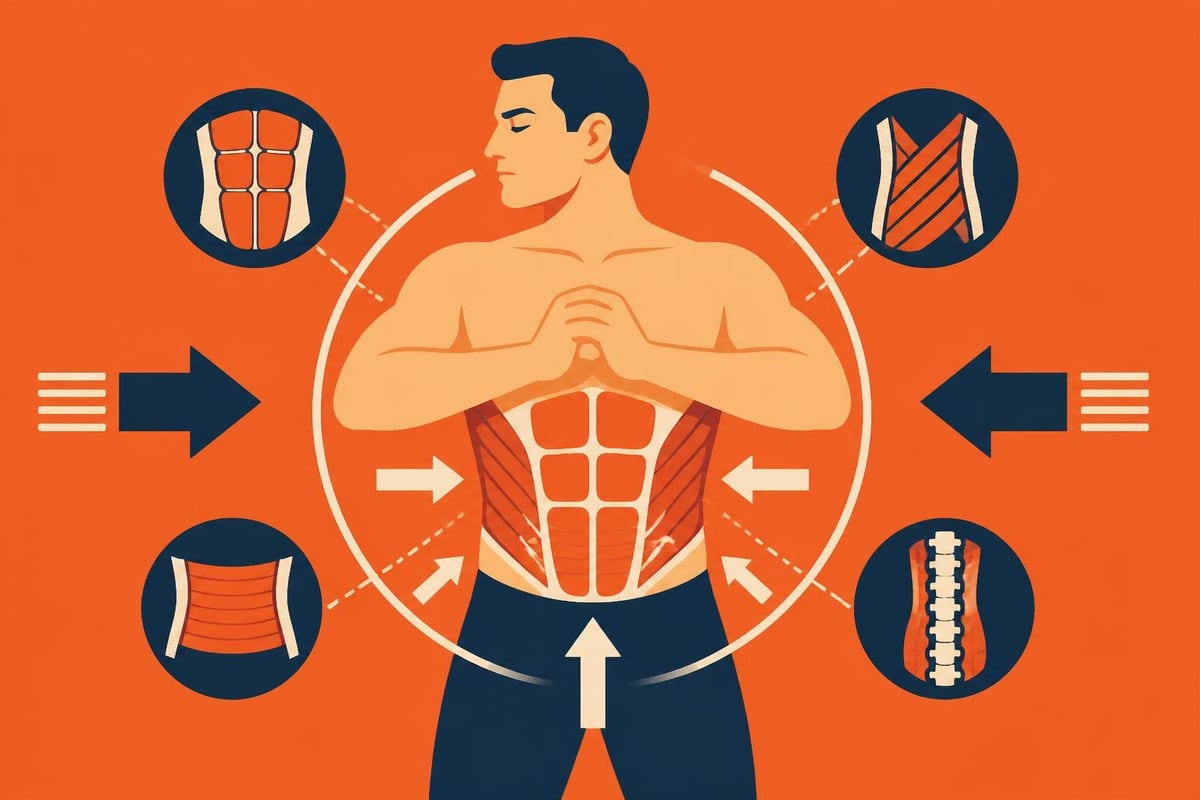
The core is not your six-pack. It's the entire cylinder of muscle wrapping your trunk: rectus abdominis, obliques, transverse abdominis, erector spinae, multifidus, and deeper stabilizers you'll never see in a mirror. These muscles work together to resist unwanted motion, transfer force between your upper and lower body, and protect your spine under load.
Ab workouts train these functions when designed correctly. Harvard Health Publishing outlines core exercises that improve balance, reduce back pain, and enhance athletic performance. Those outcomes matter more than appearance because they determine what you can do. A strong core lets you lift your kid overhead without wincing, haul firewood without tweaking your back, and move confidently through your forties and beyond.
Most men have this backward. They think ab workouts create abs. Abs are revealed by losing fat, which happens in the kitchen and through total-body training. Ab workouts create the strength and stability that make every other lift safer and more effective.
The Anti-Movement Framework
Your core's job is to prevent your spine from flexing, extending, rotating, or side-bending under load. Every effective ab workout trains one or more of these anti-movement patterns:
Anti-extension: Resisting spinal extension (arching). Exercises like planks, dead bugs, and rollouts.
Anti-flexion: Resisting spinal flexion (rounding). Loaded carries, back extensions, and deadlifts train this indirectly.
Anti-rotation: Resisting rotation. Pallof presses, suitcase carries, and single-arm farmer's walks.
Anti-lateral flexion: Resisting side-bending. Side planks, single-arm overhead carries.
This framework shifts ab workouts from random movements to purposeful training. You're not just "working abs." You're teaching your core to stabilize under real-world demands. That's the difference between a father who can play hard with his kids and one who throws his back out tying his shoes.
The World Health Organization recommends muscle-strengthening activities on two or more days per week. Core work fits within that framework, not outside it. Your ab workouts don't need to be daily. They need to be deliberate.
Programming Ab Workouts That Build Strength
Frequency, volume, and progression determine whether your ab workouts produce results or just fatigue. Most men fail because they program core work like cardio: high reps, every day, no progression. That approach builds endurance in movements you'll never use and ignores the strength that actually transfers.
Frequency and Volume
Train abs two to four times per week. More is not better. Your core works during every compound lift, every loaded carry, and most daily tasks. Direct ab work is supplemental, not primary.
Each session should include:
One anti-extension exercise
One anti-rotation exercise
One anti-lateral flexion or oblique-focused exercise (optional, depending on total volume)
Keep total sets between four and eight per session. Quality beats quantity. A hard set of Pallof presses, held for time with perfect tension, does more than fifty sloppy crunches.
Training Level | Weekly Frequency | Sets Per Session | Rest Between Sets |
|---|---|---|---|
Beginner | 2-3 days | 4-6 | 60-90 seconds |
Intermediate | 3-4 days | 6-8 | 45-60 seconds |
Advanced | 3-4 days | 6-10 | 30-60 seconds |
Progression Standards
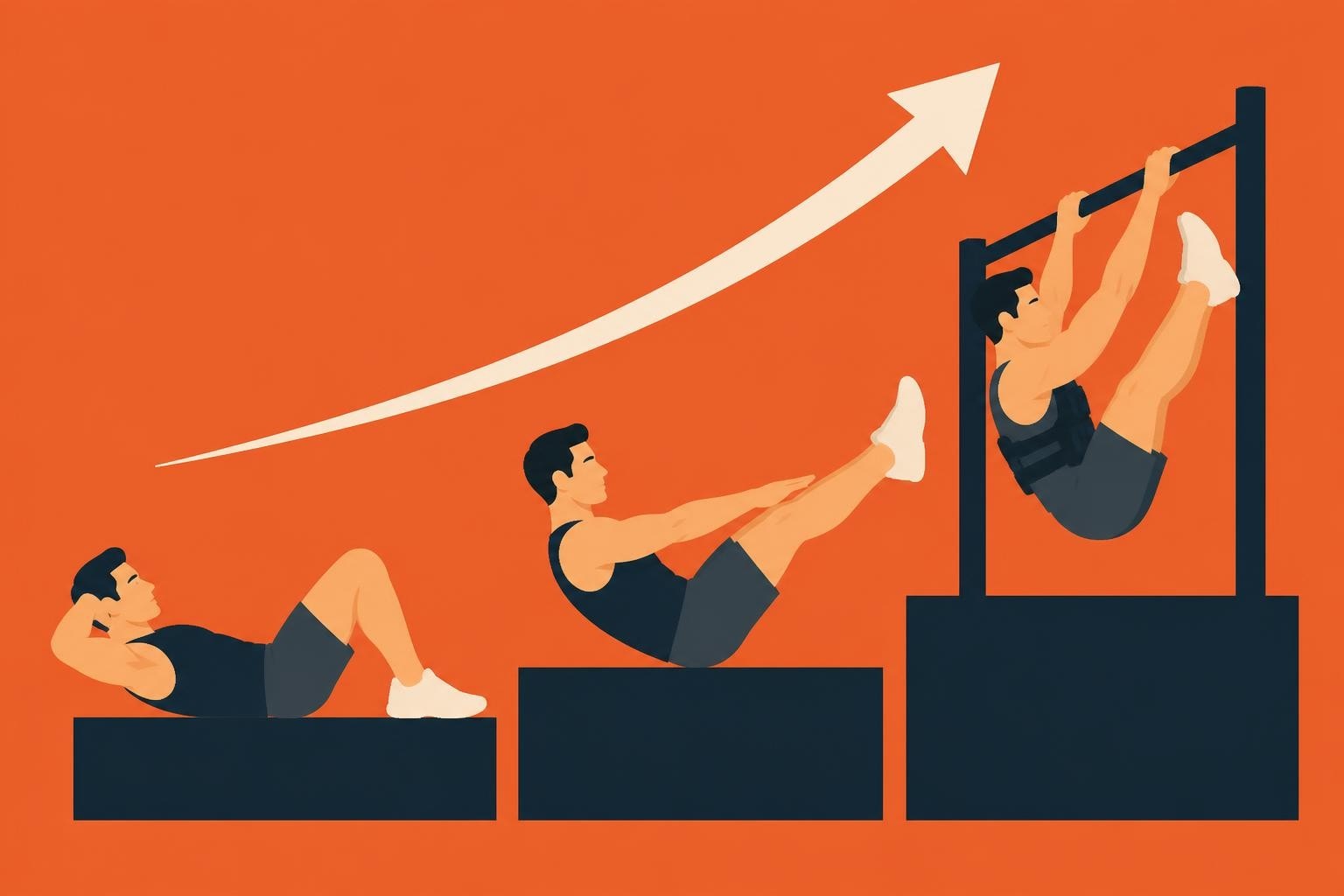
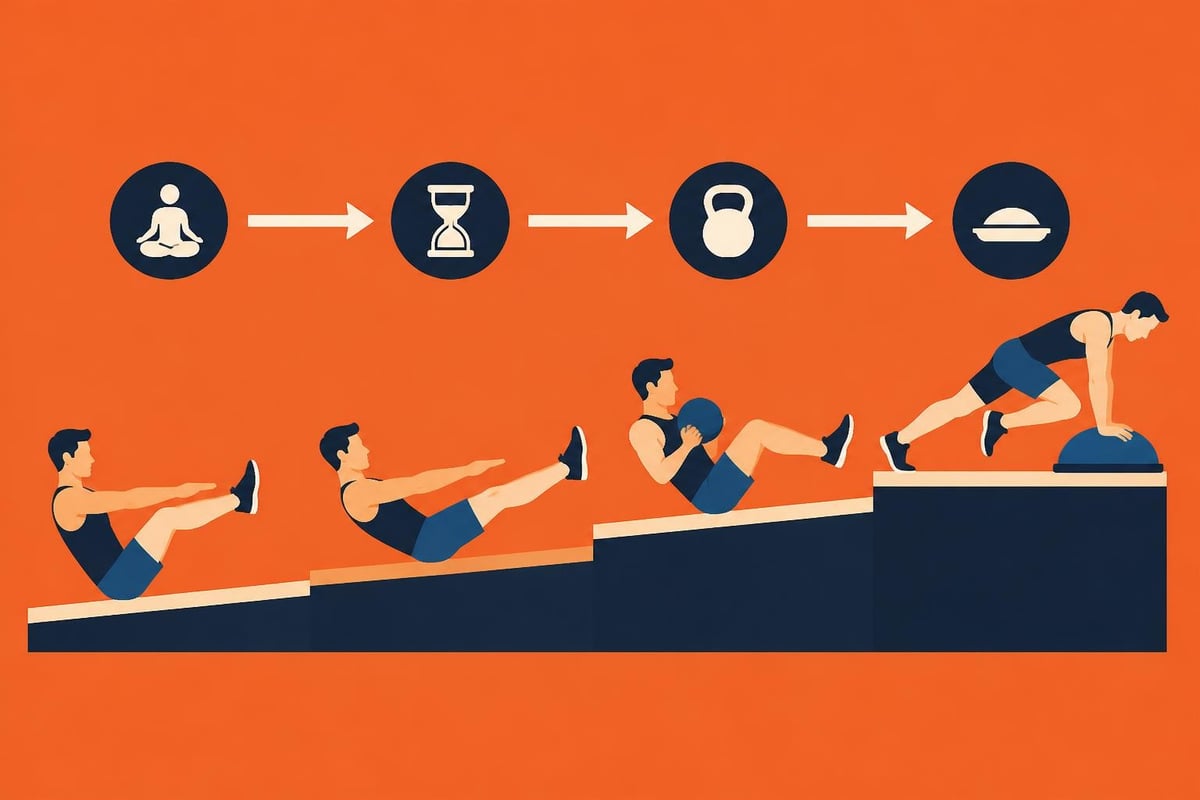
Ab workouts must get harder over time. Progression follows this hierarchy:
Improve position and breathing: Master the movement pattern with proper bracing and controlled breath before adding difficulty.
Increase time under tension: Hold planks longer, slow down rollouts, add pauses.
Add external load: Weight vests for planks, bands for Pallof presses, weight for dead bugs.
Increase lever length: Progress from knee tucks to full rollouts, from knee planks to feet-elevated planks.
Reduce base of support: Single-leg dead bugs, single-arm planks, unstable surfaces (use sparingly).
Most men skip step one and wonder why their back hurts. Position and breath are non-negotiable. If you can't maintain a neutral spine and brace hard under pressure, adding weight just trains dysfunction.
Exercise Selection and Execution
The best ab workouts use a small menu of exercises done well. Variety for its own sake is distraction. Master these categories, and you'll build a core that serves you for decades.
Anti-Extension Movements
These prevent your lower back from arching under load. They're the foundation of safe lifting and the most commonly butchered category.
Plank variations: Standard plank, feet-elevated plank, RKC plank (maximal tension), tall-kneeling plank.
Dead bugs: Lie on your back, extend opposite arm and leg while keeping your lower back flat. No arching. Slow and controlled.
Ab-wheel rollouts: The king of anti-extension. Start from knees, progress to feet. Keep your hips extended and core locked.
Execution non-negotiables: Squeeze glutes, brace abs like someone's about to punch you, breathe behind the brace. If your lower back arches, the set is over. No exceptions.
Anti-Rotation Movements
These teach your core to resist twisting forces. They transfer directly to lifting, throwing, and any movement requiring power transfer.
Pallof press: Stand perpendicular to a cable or band, press it straight out, and hold. The resistance tries to rotate you. You resist.
Suitcase carries: Carry a heavy weight in one hand. Walk slow and tall. Don't lean.
Single-arm farmer's walks: Same concept, heavier load, more challenge.
The key is resisting motion, not creating it. Russian twists and wood chops have their place, but anti-rotation builds the stability that matters most.
Anti-Lateral Flexion and Oblique Work
These prevent side-bending and train the obliques functionally.
Side planks: From forearm, stack feet, elevate hips. Progress to single-leg or weighted.
Single-arm overhead carries: Carry weight overhead in one hand. Walk tall. This hammers obliques and shoulders simultaneously.
Landmine rotations: Controlled, loaded rotation. Use these sparingly and only after mastering anti-rotation.
Obliques get worked during heavy carries and compound lifts. Direct oblique work is low priority unless you're rehabbing or have specific sport demands.
Common Mistakes and How to Fix Them
Ab workouts fail for predictable reasons. Identifying the error is easy. Fixing it requires discipline.
Mistake One: Training Abs in Isolation
Your core doesn't work alone. It stabilizes during squats, deadlifts, overhead presses, and carries. If you're not doing those lifts, your ab workouts won't translate. Research on core training in athletes shows that core work enhances performance when paired with sport-specific training, not when done in a vacuum.
Fix: Program ab workouts after your main lifts. Use them to reinforce stability patterns, not replace them.
Mistake Two: Chasing the Burn
The burn is metabolic stress, not strength. High-rep crunches create fatigue without building the stability or strength that protects your spine.
Fix: Train for quality and tension, not exhaustion. If you can do more than 20 reps, make the exercise harder.
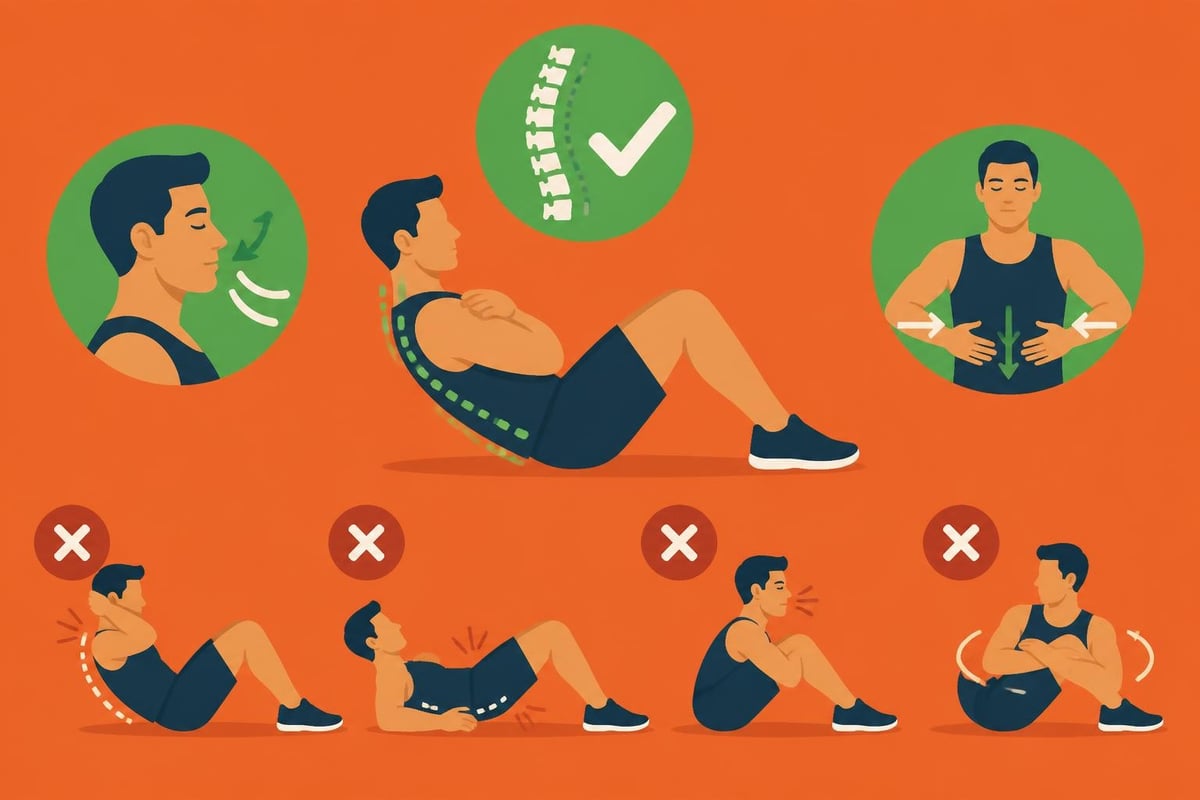
Mistake Three: Ignoring Breath and Bracing
If you're not breathing behind a hard brace, you're not training your core. You're flopping around.
Fix: Inhale through your nose, brace your abs like you're about to take a punch, then execute the movement while maintaining that tension. Exhale slowly without losing the brace. This is how you lift heavy and how you protect your spine during ab workouts.
Mistake | Symptom | Fix |
|---|---|---|
Isolated ab training | No carryover to real movement | Pair with compound lifts and carries |
Chasing the burn | High reps, no strength gain | Reduce reps, increase difficulty |
Poor breathing | Lower back pain, no brace | Practice diaphragmatic breathing daily |
Daily ab training | Fatigue, no progress | Reduce frequency, increase intensity |
No progression | Plateau after initial gains | Add load, time, or lever length |
Mistake Four: Training Through Pain
Discomfort is normal. Pain is a signal. If ab workouts hurt your lower back or neck, your form is broken or the exercise is beyond your current capacity.
Fix: Regress the movement. A perfect dead bug beats a sloppy rollout every time. Cochrane reviews on exercise therapy for chronic low back pain confirm that core exercises reduce pain and improve function, but only when executed correctly.
Integrating Ab Workouts Into Your Training Week
Ab workouts don't exist in isolation. They support your total training plan. Integration is what separates men who see results from men who waste time.
Sample Weekly Structure
Here's a four-day training split with ab workouts integrated:
Day 1: Lower Body
Squats, Romanian deadlifts, Bulgarian split squats
Finish with: 3 sets dead bugs, 2 sets side plank (each side)
Day 2: Upper Body Push
Bench press, overhead press, dips
Finish with: 3 sets ab-wheel rollouts, 2 sets Pallof press
Day 3: Lower Body or Conditioning
Deadlifts, lunges, loaded carries
Carries train anti-lateral flexion. No additional ab work needed.
Day 4: Upper Body Pull
Rows, pull-ups, face pulls
Finish with: 3 sets plank variations, 2 sets suitcase carries
This structure hits every anti-movement pattern twice per week without redundancy. Your core gets trained four days, but only two require dedicated ab workouts. The other two days use carries and compound lifts.
Standalone Ab Sessions
If you need a standalone session (travel, limited equipment, rehab focus), keep it short and purposeful:
Warm-up: Dead bugs, 2 sets of 10 controlled reps
Anti-extension: Ab-wheel rollouts or planks, 3 sets
Anti-rotation: Pallof press or single-arm carries, 3 sets
Anti-lateral flexion: Side planks or overhead carries, 2 sets each side
Total time: 15-20 minutes. Done correctly, that's more effective than an hour of mindless crunches.
The Role of Nutrition and Recovery
Ab workouts build the muscle. Nutrition reveals it. Recovery lets you train again without breaking down. You can't separate these.
Revealing Your Abs
Visible abs require low body fat. For most men, that's 10-12% or below. Getting there demands a calorie deficit, high protein intake, and patience. Ab workouts won't create definition if you're carrying excess fat. They'll build strength underneath, which matters more, but the mirror won't show it.
Protein target: 0.8-1.0 grams per pound of body weight daily.
Calorie deficit: 300-500 calories below maintenance for sustainable fat loss.
Consistency: Months, not weeks. No shortcuts.
Recovery Protocols
Your core recovers faster than larger muscle groups, but it still needs rest. Soreness in your abs the day after heavy ab workouts is normal. Persistent pain is not.
Sleep: 7-9 hours nightly. Non-negotiable.
Hydration: Dehydration impairs muscle function and recovery.
Active recovery: Walking, light carries, and mobility work support recovery without adding fatigue.
If you're a father balancing work, family, and training, recovery isn't optional. It's the difference between progress and injury. The Father Forge builds custom fitness programs that account for real life, not just gym time, because results happen when training, nutrition, and recovery align with your actual schedule.
Advanced Strategies for Experienced Lifters
Once you've mastered the basics, ab workouts can be refined for specific goals: heavier lifts, better posture, or sport performance.
Loaded Carries as Core Training
Carries are the most underrated ab workout. They train every anti-movement pattern simultaneously while building grip, shoulder stability, and mental toughness.
Farmer's walks: Heavy weight in each hand. Walk 40-60 yards.
Suitcase carries: Heavy weight in one hand. Walk slow, resist leaning.
Overhead carries: Weight overhead in one or both hands. Shoulders stacked, core locked.
Progress by adding weight, not distance. A 50-yard carry with perfect posture beats a 100-yard wobble.
Tempo and Isometric Emphasis
Slowing down ab workouts or adding pauses increases time under tension and teaches positional control.
Tempo dead bugs: 3-second lower, 1-second pause, 1-second return.
Pause planks: Hold, then elevate one foot for 5 seconds, switch.
Eccentric rollouts: 5-second rollout, fast return.
These variations build strength in ranges of motion where most men are weak.
Breathing Drills as Core Work
Breathing isn't separate from core training. It's foundational. Poor breathing sabotages bracing and destabilizes your spine.
90/90 breathing drill:
Lie on your back, knees and hips at 90 degrees, feet elevated.
Inhale through your nose, filling your belly and lower ribs.
Exhale fully through your mouth, feeling your abs contract and ribs drop.
Repeat for 5-10 breaths before ab workouts.
This drill resets your diaphragm and teaches you to brace correctly. ACE Fitness research on core training emphasizes the integration of breathing mechanics with core stability for long-term function.
Tailoring Ab Workouts to Your Life Stage
Fathers over 35 face different demands than men in their twenties. Your ab workouts should reflect that reality.
Age-Related Considerations
Recovery slows: You need more sleep, better nutrition, and smarter programming. Training abs every day worked at 25. At 40, it just grinds you down.
Injury history accumulates: Old back tweaks, shoulder issues, and hip tightness limit exercise selection. Choose movements that build strength without aggravating past injuries.
Time is limited: You have work, kids, and responsibilities. Your ab workouts must be efficient. Fifteen focused minutes beats an hour of wasted motion.
Building a Sustainable Routine
Sustainability matters more than intensity. The best ab workout is the one you'll do consistently for the next decade.
Start with two sessions per week. Add a third only when the first two are non-negotiable habits. Use the same exercises for at least four weeks before changing. Progression happens through mastery, not novelty.
Beginner template (2x/week):
Plank: 3 sets, 20-40 seconds
Dead bug: 3 sets of 8-10 per side
Side plank: 2 sets of 15-30 seconds per side
Intermediate template (3x/week):
Ab-wheel rollouts: 3 sets of 8-12
Pallof press: 3 sets of 10-12 per side
Suitcase carry: 2 sets of 40 yards per side
Advanced template (3-4x/week):
Loaded carries (variety): 3 sets
Tempo dead bugs or rollouts: 3 sets
Side plank variations: 2 sets per side
Track your sessions. Write down sets, reps, and load. Progress happens when you measure it.
The Accountability Standard
Ab workouts reveal your discipline. They're easy to skip, easy to half-ass, and easy to rationalize away. That's exactly why they matter.
If you can't show up for a fifteen-minute ab session, you won't show up when your kids need you at 2 a.m. or when your marriage requires hard conversations. Training is a mirror. It shows you who you are when no one's watching.
Research from the American College of Sports Medicine outlines exercise prescription standards that work, but standards only matter if you follow them. Information doesn't build strength. Action does.
Set the standard. Meet it. Repeat. That's the only ab workout philosophy that lasts.
Ab workouts build core strength that supports every movement in the gym and every responsibility at home, but only when programmed with purpose and executed with discipline. If you're ready to train with a plan built around your real life, your actual schedule, and your specific goals, The Father Forge creates custom fitness and mindset programs that integrate strength, accountability, and leadership into a system you can sustain for decades.