
30 Minute Workout Routine: Build Strength Fast
Most men don't fail because they lack a good 30 minute workout routine. They fail because they lack the environment that enforces it. You can have the perfect program, the ideal exercise selection, and the most efficient rest periods. None of that matters if you operate in isolation without accountability. The difference between results and excuses comes down to leadership, starting with how you lead yourself. This article provides the structure you need, but remember: information without implementation is just entertainment.
The Foundation: Why 30 Minutes Works
Time scarcity is real for fathers over 35. You have careers, families, obligations that don't negotiate. The question isn't whether you have time. The question is whether you'll use the time you have with precision.
A 30 minute workout routine works because it removes the biggest obstacle to consistency: overthinking. When you only have 30 minutes, you can't waste 10 minutes scrolling your phone between sets. You can't spend 15 minutes deciding what to do next. You execute the plan or you fail.
The structure forces accountability to yourself.This matters more than the exercises you choose. Most programs fail not from poor design but from poor enforcement. Men skip workouts, cut sessions short, or go through the motions because no one is watching. That's a leadership failure, not a programming failure.
The Three Pillars of Effective Short Training
Every efficient 30 minute workout routine must satisfy three non-negotiable requirements:
Compound movements first: Multi-joint exercises that engage maximum muscle mass
Minimal transition time: Equipment and exercise sequencing that keeps you moving
Progressive overload tracking: Written records that prove you're advancing weekly
When these three elements align, 30 minutes becomes sufficient. When any element is missing, you're just burning time and calling it training.

The Upper Body Protocol
Your upper body session prioritizes pushing and pulling in equal measure. Muscular imbalances create injury. Injury creates excuses. Excuses destroy consistency.
Push-Pull Structure
Start with a compound press, follow with a compound pull. This30-minute full-body strength training approachmaximizes mechanical tension while managing fatigue.
ExerciseSetsRepsRestBarbell Bench Press46-890 secBarbell Row46-890 secOverhead Press38-1060 secPull-Ups/Lat Pulldown38-1060 secDips212-1545 sec
Execute this exactly as written. Don't add exercises because you think more equals better. More equals scattered effort and diminished results.
Rest periods are prescribed for a reason.Shorten them and you compromise strength. Extend them and you run out of time. Follow the protocol.
The final two minutes are for core work. Planks, dead bugs, or hollow holds. These aren't optional accessories. Core stability protects your spine under heavy loads. Skip them and you're gambling with your ability to show up next week.
The Lower Body Protocol
Lower body training demands respect. Your legs contain the largest muscle groups in your body. Training them properly creates systemic adaptations that affect everything else.
Start with a squat variation.Barbell back squat, front squat, or goblet squat depending on your setup. The pattern matters more than the implement.
The Session Framework
Main squat movement: 4 sets, 6-8 reps, 2 minutes rest
Hip hinge movement: 3 sets, 8-10 reps, 90 seconds rest
Single-leg movement: 3 sets, 10-12 reps per leg, 60 seconds rest
Loaded carry or sled push: 2 sets, maximum distance in 60 seconds
This structure builds strength, muscle, and work capacity simultaneously. Each component serves a purpose. The bilateral movements create force production. The unilateral work addresses imbalances. The conditioning finisher builds mental toughness while burning fat.
Men often ask if they should add calf raises or hamstring curls. You can. But only after you've executed the primary movements with intensity that borders on uncomfortable. Accessories come after fundamentals, never before.
Full Body Training Strategy
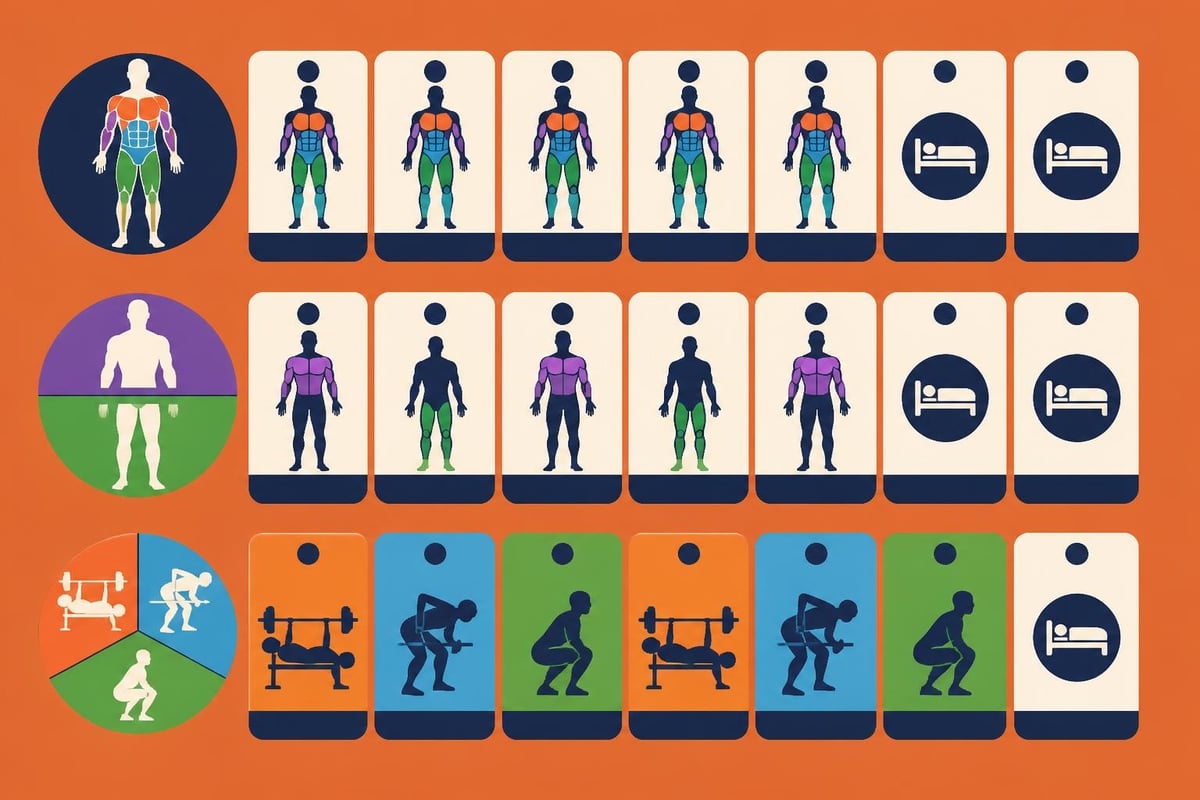
When you can only train three days per week, full body sessions make sense. This approach, featured in manycomprehensive 30-minute workout routines, allows you to hit each muscle group multiple times weekly.
Sample Full Body Layout
Workout A:
Squat pattern (4x6-8)
Horizontal push (3x8-10)
Horizontal pull (3x8-10)
Core circuit (2 rounds)
Workout B:
Hip hinge pattern (4x6-8)
Vertical push (3x8-10)
Vertical pull (3x8-10)
Loaded carry (2x60 seconds)
Workout C:
Lunge variation (3x10-12)
Push-up variation (3x12-15)
Row variation (3x12-15)
Conditioning finisher (Tabata or EMOM)
Alternate A-B-C across the week. Monday could be A, Wednesday B, Friday C. Next week starts with A again. This creates frequency without redundancy.
The key is tracking. Write down every weight, every rep. If you benched 185 for 8 last week, you need 185 for 9 or 190 for 8 this week. Progress is not a feeling. It's a number that increases.
HIIT and Metabolic Conditioning
High-intensity interval training fits perfectly into 30 minutes. This30-minute HIIT workout structureburns significant calories while preserving muscle mass.
The protocol is simple:
5 minutes: Dynamic warmup and movement prep
20 minutes: Work intervals alternating with rest
5 minutes: Cool down and mobility
For the work intervals, choose between two approaches. Option one: 40 seconds work, 20 seconds rest, 6 exercises, 4 rounds. Option two: 30 seconds work, 30 seconds rest, 5 exercises, 6 rounds.
ExerciseDurationIntensityKettlebell Swings40 secMaximum effortRest20 secActive recoveryBurpees40 secMaximum effortRest20 secActive recoveryBox Jumps40 secMaximum effortRest20 secActive recovery
Repeat this circuit until 20 minutes elapse. Track total rounds completed. This becomes your benchmark to beat next session.
The mistake men make with HIIT is treating every session like a max effort test. You can't sprint every day and call it training. That's just accumulating fatigue. Use HIIT strategically: 1-2 times weekly alongside strength work, or 3 times weekly during fat loss phases.
Equipment and Environment Considerations
Your training environment directly impacts your results. A home gym with a barbell, rack, bench, and pull-up bar provides everything needed for a complete 30 minute workout routine. Commercial gyms work if you train during off-peak hours when equipment access is guaranteed.
Minimal Equipment Setup
If you're building from scratch, prioritize in this order:
Adjustable dumbbells or kettlebells (immediate versatility)
Pull-up bar or rings (back development you can't skip)
Flat bench (enables pressing variations)
Barbell and plates (progressive overload becomes easier)
Squat rack or stands (safety under heavy loads)
Everything else is optional. Machines, cables, specialty bars, these add variety but aren't essential. Men spend thousands on equipment they don't need while skipping workouts they should be doing with what they have.
The environment must remove friction.If your training space requires 10 minutes of setup, you've lost one-third of your session before it starts. Organize your area so you can start working within 60 seconds of deciding to train.
Many fathers benefit from the accountability structure found ingroup coaching environmentswhere other men enforce the standard you're trying to meet. Brotherhood removes the option to negotiate with yourself when motivation fades.
Programming Progression and Adaptation
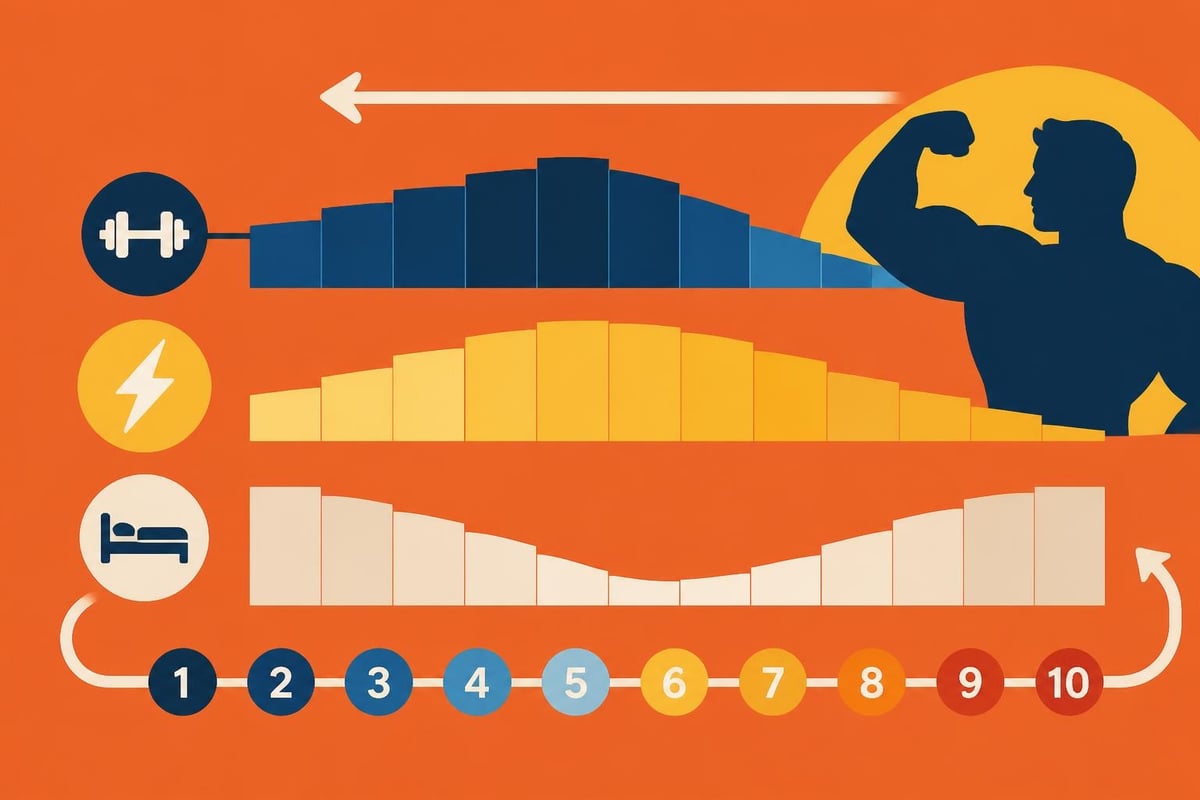
A 30 minute workout routine only works long-term if it progresses. Your body adapts to stress by becoming stronger. Once adaptation occurs, the same stimulus produces diminished results.
Linear progression works for beginners.Add 5 pounds to upper body lifts and 10 pounds to lower body lifts each week. Continue until you can't complete the prescribed reps. Then reset to 90% of your max and rebuild.
Intermediate lifters need weekly variation. Heavy day (4-6 reps), moderate day (8-10 reps), light day (12-15 reps). This approach, similar to methods used inefficient muscle-building programs, manages fatigue while creating multiple adaptation pathways.
Periodization Example
WeekIntensityVolumeFocus1-375%HighHypertrophy base4-685%MediumStrength building7-990%LowPeak strength1060%LowDeload recovery
Repeat this cycle with adjusted baselines. Your week one of cycle two should use weights that were challenging in week three of cycle one. This creates progress across months, not just days.
Men often plateau because they train randomly. Monday they do whatever feels good. Wednesday they try a new program they saw online. Friday they skip because they're tired. This isn't training. It's exercise tourism.
Nutrition Timing Around Training
What you eat matters. When you eat around training matters more than most realize. A 30 minute workout routine creates metabolic demand. Your nutrition either supports recovery or undermines it.
Pre-workout nutrition: 90-120 minutes before training.Protein and moderate carbohydrates. Chicken and rice. Eggs and oatmeal. Greek yogurt and fruit. This provides fuel without causing digestive distress during movements.
Post-workout nutrition: within 60 minutes after training. Protein and carbohydrates again, but higher carb ratio. Your muscles are primed to absorb nutrients. Missing this window doesn't eliminate results, but it slows them.
For fathers managing busy schedules, meal prep removes decision fatigue. Cook once, eat multiple times. Invest 90 minutes on Sunday preparing proteins and starches. Store them properly. Execute the plan during the week.
The men who transform their bodies don't possess superior willpower. They possess superior systems that make the right choices automatic. Willpower is a limited resource that depletes. Systems run regardless of how you feel.
Recovery and Adaptation Protocols
Training creates the stimulus. Recovery creates the adaptation. Most men understand this intellectually but ignore it practically.
Sleep is non-negotiable. Seven to nine hours nightly. Not seven one night and five the next. Consistent sleep schedules that allow your body to regulate cortisol and testosterone properly.
Active recovery strategies:
10-15 minutes daily walking
Mobility work on off days
Light stretching before bed
Foam rolling tight areas
Adequate hydration throughout the day
These aren't luxuries for people with extra time. They're requirements for people who want results. Your body doesn't distinguish between training stress, work stress, and family stress. It only knows total load. Manage recovery or accept diminished progress.
Some men benefit from structured reset programs likeDoResetthat help rebuild habits systematically when old patterns stop working. Breaking down and rebuilding isn't weakness. It's strategic repositioning.
Mental Framework for Consistency
The physical training protocol matters less than the mental framework that ensures you execute it. A perfect program you skip beats an adequate program you complete.
The Three Accountability Questions
Ask these before every session:
Did I show up when I said I would?
Did I complete what I planned to complete?
Did I record my performance to track progress?
If you answer yes to all three, you succeeded regardless of how the weights felt. If you answer no to any, you failed regardless of how good your pump was.
This is where most men lose.They show up inconsistently. They modify programs mid-session based on energy levels. They forget to track and therefore can't prove they're progressing. Then they wonder why six months later they look the same.
The 30 minute workout routine isn't magic. It's just concentrated effort applied consistently over time. Magic implies something happens without work. This requires work. It just requires less time than you think and more discipline than you've been applying.
Common Execution Errors
Men sabotage their own progress through predictable patterns. Identifying these prevents you from wasting months.
Error one: Adding volume constantly.More sets don't equal more results. They equal more fatigue. Stick to the prescribed volume until it stops working, then add strategically.
Error two: Training through injury.Pain during movement isn't something to push through. It's information that something is wrong. Modify or substitute exercises that don't aggravate the issue.
Error three: Ignoring rest days.Your muscles don't grow in the gym. They grow during recovery. Three to four hard sessions weekly beats six mediocre sessions.
Error four: Changing programs too frequently.You need 8-12 weeks minimum to assess if a program works. Switching every three weeks because you're not seeing dramatic changes ensures you never see changes at all.
ErrorConsequenceSolutionExcessive volumeBurnout, plateauStick to prescribed setsTraining injuredChronic issuesModify around painNo rest daysOvertrainingSchedule 3-4 days offProgram hoppingZero progressCommit 12 weeks minimum
These aren't suggestions. They're observations from watching hundreds of men fail the same ways repeatedly. You can learn from their mistakes or repeat them yourself.
Implementation Timeline
Starting a 30 minute workout routine requires a structured approach, particularly if you're returning after time away from training.
Week 1-2: Movement Pattern Focus
Prioritize technique over load. Use weights that feel too light. Record yourself performing the movements. Compare against proper form demonstrations. Thistotal-body workout foundationbuilds the base everything else depends on.
Week 3-6: Load Progression
Add weight each session. Track every increase. This is where most men see rapid strength gains as their nervous system adapts to the demands.
Week 7-12: Refinement Phase
Adjust volume and intensity based on recovery capacity. Some exercises may need increased frequency. Others may need reduced volume. Listen to your body but don't negotiate with it.
After 12 weeks, assess. Compare current performance to starting baseline. If you're significantly stronger across all movements, continue the program with progressive overload. If progress stalled, change variables: exercise selection, rep ranges, training frequency.
Beyond the Training Session
A 30 minute workout routine is a component of a larger system. Training addresses physical capacity. But fathers need more than strength. They need resilience, emotional regulation, and leadership capacity.
The complete transformation requires:
Structured training that progresses weekly
Nutrition that supports recovery and body composition goals
Sleep protocols that allow adaptation
Stress management that prevents cortisol dominance
Brotherhood that enforces standards when motivation fades
No single element dominates. Each supports the others. Neglect one and the system weakens. This is why programs atThe Father Forgeaddress the complete picture rather than just exercise selection.
You're not just building muscle. You're building the man your family needs you to be. That requires more than workout programs. It requires accountability structures, mindset frameworks, and men who won't let you quit when things get hard.
Tracking and Measurement Systems
What gets measured gets managed. What gets managed improves. Your training log is not optional documentation. It's the accountability system that separates progress from delusion.
Required Tracking Metrics
Every training session should record:
Date and time of workout
Exercises performed in order
Weight used for each set
Reps completed for each set
Rest periods between sets
Subjective difficulty rating (1-10 scale)
Total session duration
Use a notebook, spreadsheet, or app. The medium doesn't matter. Consistency matters. Reference previous sessions before each workout. Know exactly what you need to beat.
Monthly measurements:
Body weight (same day, same time weekly)
Waist circumference (at navel)
Progress photos (front, side, back)
One-rep max estimates on main lifts
This data tells you whether your program works. If measurements improve, continue. If they stagnate, adjust variables. If they worsen, change course immediately.
Men resist tracking because it removes the ability to deceive themselves. When everything is recorded, you can't claim you're working hard while doing the same weights you used six months ago. The log doesn't lie. Use it.
The 30 minute workout routine works when you remove the variables that prevent consistency: unclear programming, no tracking systems, and training in isolation without accountability. You now have the structure required to build strength and muscle efficiently. The Father Forge provides the accountability, brotherhood, and complete system that transforms information into results through custom programming and weekly coaching designed specifically for fathers who lead families while building themselves. Start your transformation atThe Father Forge.