
30 Minute Workout: The Standard for Busy Fathers
You don't lack knowledge about fitness. You lack a system that works within the constraints of your life. A 30 minute workout is not a compromise. It is a standard you can hold consistently while leading a family, building a career, and refusing to let your health slide. The issue is not duration. The issue is structure, intensity, and whether you show up when the day tries to take that block of time from you. This is about designing a session that delivers results without requiring you to abandon your other obligations.
Why Thirty Minutes Is Enough
The Physical Activity Guidelines for Americans recommend 150 minutes of moderate-intensity aerobic activity or 75 minutes of vigorous-intensity activity per week, plus two days of strength training. A 30 minute workout, performed five times weekly at appropriate intensity, meets or exceeds that standard. The constraint is not time. The constraint is your willingness to push hard enough during the time you have.
Intensity is the variable most men fail to control. A half-hearted hour yields less than a focused thirty minutes. When you strip away rest between sets that serves no purpose, eliminate unnecessary exercises, and move with intent, you compress the effective work into a shorter window. That compression requires you to show up ready. No phone. No distractions. No easing into it.
What the Research Shows
Research on whole-body high-intensity interval training demonstrates that short, intense sessions produce measurable improvements in cardiovascular fitness and body composition. The study compared HIIT protocols to traditional moderate-intensity continuous training and found that time-efficient sessions deliver comparable or superior outcomes when intensity is sufficient. The takeaway is not that shortcuts work. The takeaway is that wasted time in the gym is optional.
A 30 minute workout forces you to prioritize. You cannot afford filler exercises or excessive warm-up rituals. You select movements that serve multiple purposes: compound lifts that engage large muscle groups, conditioning intervals that elevate heart rate and build work capacity, and mobility drills that address the specific limitations created by your job and your age.
Building the Framework
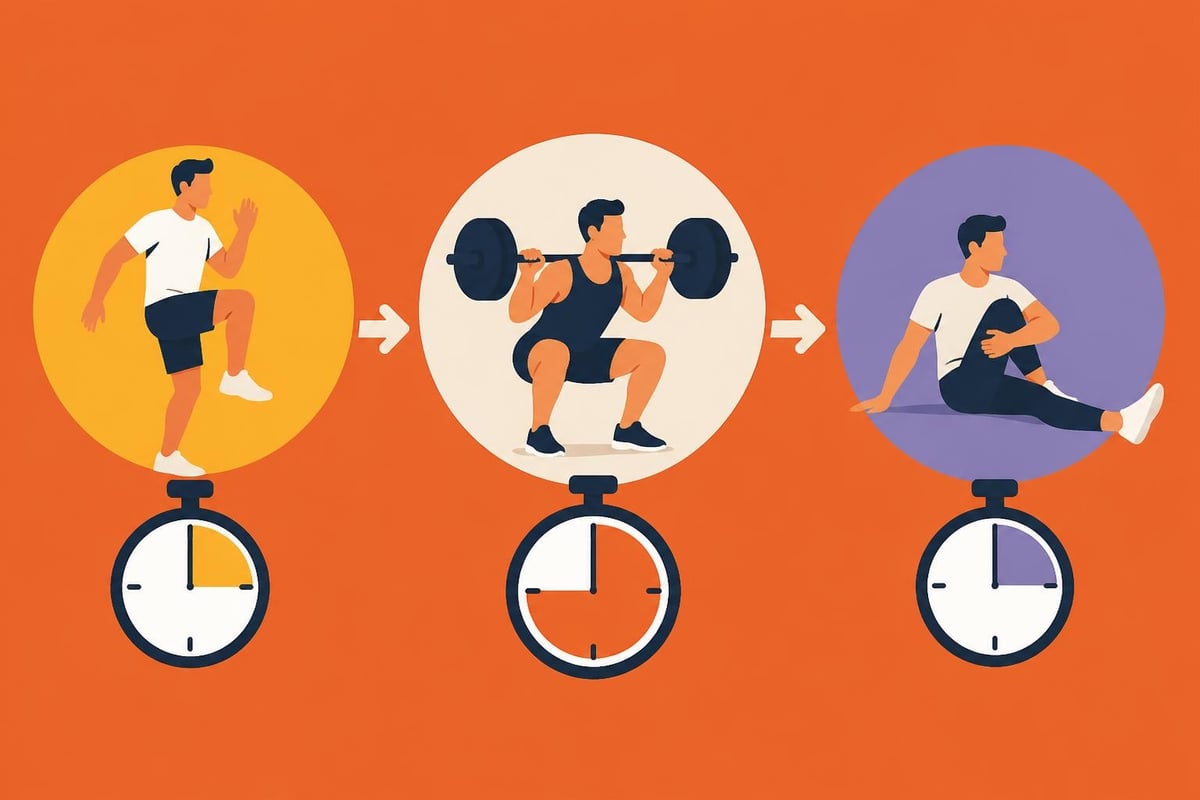
Every session requires three components: warm-up, primary work, and cool-down. The warm-up prepares your body to handle load without injury. The primary work delivers the training stimulus. The cool-down begins the recovery process and maintains range of motion. Skipping any component is borrowing from future sessions.
Warm-Up Protocol
Dedicate five minutes to dynamic movement that raises core temperature and activates the patterns you will use under load.
Arm circles and shoulder dislocations with a band or PVC pipe
Hip circles, leg swings, and walking lunges
Inchworms or bear crawls to engage the core and upper body
Light sets of the first primary movement (e.g., bodyweight squats before loaded squats)
The warm-up is not optional. It is insurance. Men over 35 do not have the recovery capacity of younger athletes. You cannot afford injuries caused by skipping preparation.
Primary Work Structure
The next twenty minutes is where you earn the session. Choose one of three formats depending on your goal for the day.
Strength Focus:
Exercise | Sets x Reps | Rest |
|---|---|---|
Squat or deadlift | 4 x 5 | 2 min |
Press or pull | 3 x 8 | 90 sec |
Core (plank, carry) | 3 x 30 sec | 60 sec |
Conditioning Focus:
Interval Type | Work | Rest | Rounds |
|---|---|---|---|
Sprints or burpees | 30 sec | 30 sec | 8-10 |
Kettlebell swings | 40 sec | 20 sec | 6-8 |
Sled push or row | 20 sec | 40 sec | 10 |
Hybrid (Strength + Conditioning):
Pair a strength movement with a conditioning finisher. Example: 4 rounds of 5 goblet squats, followed immediately by 10 push-ups and 15 kettlebell swings, resting 90 seconds between rounds.
The format matters less than the principle: every minute has a purpose. If you finish early, you did not work hard enough. If you cannot complete the prescribed work in twenty minutes, your intensity or your movement efficiency needs correction.
Cool-Down and Mobility
The final five minutes address the areas your job and your training neglect. Fathers who sit at desks need hip flexor and thoracic spine mobility. Fathers who stand or lift need ankle and shoulder work. This is not stretching for the sake of stretching. This is maintaining the capacity to move well tomorrow.
Couch stretch or pigeon pose for hip flexors
Cat-cow or wall angels for thoracic extension
Banded shoulder distraction for overhead range
Foam rolling or lacrosse ball work on tight areas
What to Do When Equipment Is Limited
A 30 minute workout does not require a full gym. Bodyweight movements, a single kettlebell, or a set of resistance bands deliver enough stimulus if you control intensity and progression. The NHS home workout videos demonstrate that effective sessions can be built around minimal gear.
Bodyweight Template:
Warm-up: Jumping jacks, arm circles, bodyweight squats (5 min)
Primary work: 5 rounds of 10 push-ups, 15 squats, 10 rows (using a table edge or suspension strap), 20-second plank (15 min)
Cool-down: Hip flexor stretch, thoracic rotations, child's pose (5 min)
Single Kettlebell or Dumbbell Template:
Warm-up: Halos, goblet squats, arm swings (5 min)
Primary work: 4 rounds of 8 goblet squats, 6 single-arm presses per side, 12 swings, 30-second farmer carry (16 min)
Cool-down: Shoulder and hip mobility (4 min)
The equipment is not the limitation. Your willingness to push hard without external validation is the limitation. A garage, a basement, or a hotel room is sufficient if you show up and do the work.
Programming Across the Week
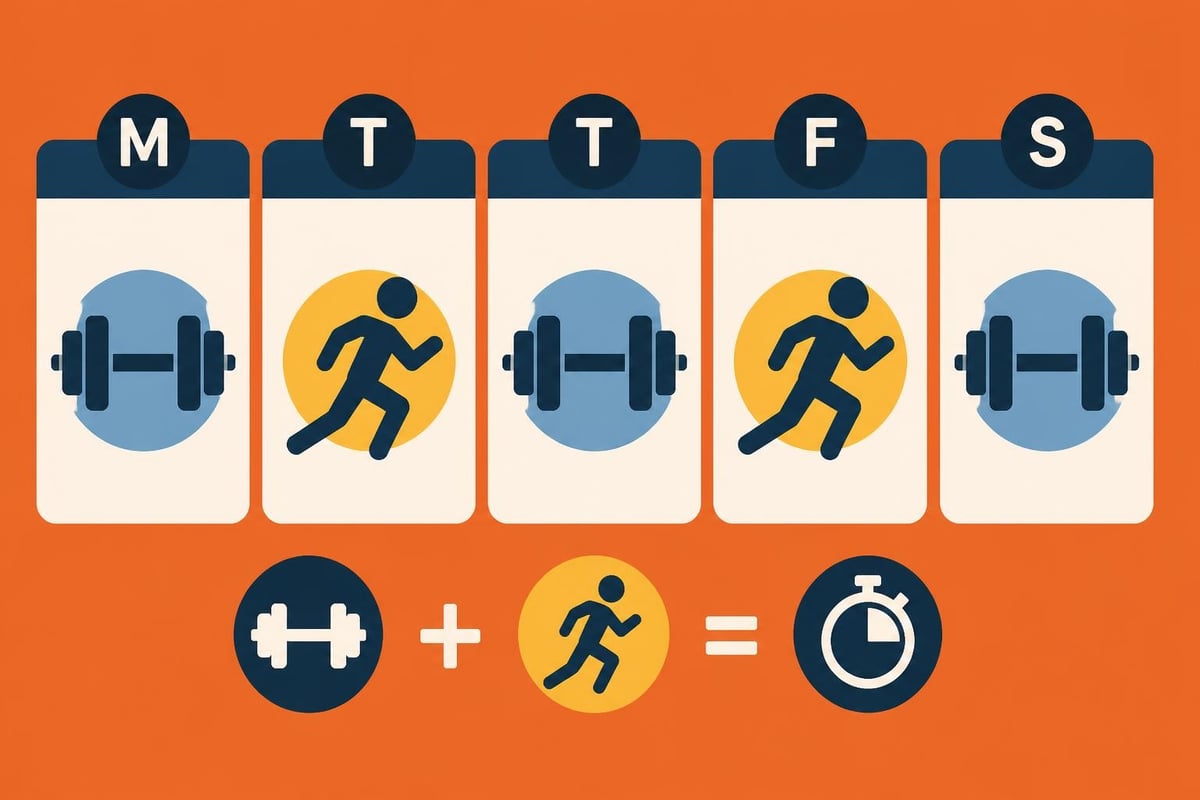
A single 30 minute workout is a data point. A week of structured sessions is a pattern. A month is proof of commitment. Programming means arranging sessions so they build on each other without creating injury or burnout.
Weekly Split for Fathers
Day | Focus | Example Session |
|---|---|---|
Monday | Lower strength | Squat, lunge, core |
Tuesday | Conditioning | Intervals (sprints, swings, burpees) |
Wednesday | Rest or mobility | Walk, stretch, foam roll |
Thursday | Upper strength | Press, pull, carry |
Friday | Conditioning | EMOM or AMRAP circuit |
Saturday | Full-body strength | Deadlift variation, push-up, row |
Sunday | Rest | Active recovery (walk, play with kids) |
This split balances intensity and recovery. Two conditioning days prevent strength sessions from becoming ineffective due to accumulated fatigue. Three strength days ensure you build and maintain muscle. Rest days are not optional. They are when adaptation occurs.
If you need personalized programming that accounts for your schedule, injuries, and goals, 1-on-1 men's coaching provides custom workout design and weekly accountability with someone who has led under pressure and understands the constraints of fatherhood.
Nutrition and Supplementation Around Short Sessions
A 30 minute workout does not create the same fueling demands as a two-hour session, but nutrition still determines whether you recover and progress. Protein intake must support muscle repair. Carbohydrates must replenish glycogen if you are training intensely multiple times per week. Hydration cannot be neglected.
Pre-Workout (30-60 min before):
Light, easily digested carbohydrate (banana, rice cake, oatmeal)
Hydration (16-20 oz water)
Optional: caffeine if training early or energy is low
Post-Workout (within 60 min):
Protein (20-40 g from whole food or shake)
Carbohydrate (1:1 or 2:1 carb-to-protein ratio if session was intense)
Continued hydration
Supplements are not required, but they can fill gaps when whole food is impractical. If you are uncertain which products are worth the investment, DoseRank ranks supplements based on evidence, dose accuracy, and value, helping you avoid wasted money on underdosed or ineffective formulas.
For fathers training at home or outdoors, having reliable gear matters. Sideline Sport Supply provides affordable, durable training equipment-resistance bands, jump ropes, medicine balls-designed for real use, not just display.
The 60-minute post-training window showing protein intake, carbohydrate replenishment, and hydration as critical recovery actions after a 30-minute strength or conditioning session
Common Mistakes That Undermine Results
You can execute a 30 minute workout five days a week and still make no progress if you repeat the same mistakes. These are the patterns that keep men spinning.
Lack of Progressive Overload
If the weight, reps, or intensity do not increase over time, your body has no reason to adapt. Add one rep, five pounds, or ten seconds of work each week. Small, consistent increases compound. Stagnation does not.
Inconsistent Execution
Training Monday, Wednesday, and the following Tuesday does not build momentum. It creates a pattern of restarting. Lock in your days. Treat them as non-negotiable. The World Health Organization guidelines emphasize consistency and weekly volume, not sporadic high-effort days.
Ignoring Recovery Signals
Soreness that does not resolve, persistent fatigue, or declining performance are signals, not obstacles to push through. Rest, adjust volume, or seek guidance. Injury will cost you more time than a deload week ever will.
No Accountability
Training alone with no external check creates drift. You skip sessions. You lower standards. You convince yourself that "good enough" is acceptable. Accountability, whether through a coach, a training partner, or a structured community, keeps you honest. It is the difference between effort and results.
Intensity Techniques for Maximum Efficiency
A 30 minute workout must be dense. Density comes from controlling rest, using supersets or circuits, and incorporating intensity techniques that force adaptation without adding time.
Supersets: Pair two non-competing movements (e.g., push and pull) and perform them back-to-back with minimal rest. Example: 5 dumbbell bench presses, immediately followed by 5 bent-over rows, rest 90 seconds, repeat.
EMOM (Every Minute on the Minute): Set a timer for 10-20 minutes. At the top of each minute, perform a prescribed number of reps (e.g., 5 goblet squats). Rest the remainder of the minute. Repeat. This forces consistent work and limits rest.
AMRAP (As Many Rounds as Possible): Set a timer for 10-15 minutes. Perform a circuit of 3-5 exercises for prescribed reps. Complete as many rounds as possible with good form. Track your score. Beat it next time.
Tempo Manipulation: Slow the eccentric (lowering) phase of a lift to 3-4 seconds. This increases time under tension without requiring more weight or sets. Example: lower into a squat over 4 seconds, explode up in 1 second.
These methods are not gimmicks. They are tools that increase training stimulus within fixed time. Guidance from the American Society for Preventive Cardiology supports the use of varied intensity and session structure to optimize cardiovascular and metabolic outcomes.
Mindset and the 30 Minute Standard
A 30 minute workout is not about fitting fitness into your life. It is about proving to yourself that you can hold a standard when everything else demands your attention. The session is the smallest part. The commitment to show up, the refusal to negotiate with excuses, and the discipline to execute when you are tired-that is the work.
You do not train to look a certain way. You train because leadership at home requires strength, energy, and the capacity to be present. A father who is exhausted, in pain, or ashamed of his body cannot lead effectively. Physical fitness is not vanity. It is responsibility.
The 30 minute workout is the minimum effective dose. It is not the ceiling. As your capacity grows, you may add sessions, extend duration, or increase complexity. But the foundation is showing up for thirty focused minutes and refusing to waste them.
How to Start Tomorrow
Stop waiting for perfect conditions. You do not need a gym membership, a detailed twelve-week program, or new gear. You need a commitment to thirty minutes, a basic structure, and the willingness to start.
Pick three days this week (e.g., Monday, Wednesday, Friday).
Choose a format: bodyweight circuit, kettlebell complex, or barbell strength.
Set a timer for 30 minutes. Execute warm-up, primary work, cool-down.
Record what you did. Write it down or log it in your phone.
Repeat next week. Add one rep, one round, or five pounds.
That is the entire system. The complexity comes later. Right now, the only requirement is that you start and that you show up again.
If you need structure beyond what you can build yourself, The Father Forge creates custom fitness and mindset programs tailored to your schedule, your limitations, and your goals. The focus is not motivation. The focus is accountability, brotherhood, and a system that works when life gets hard.
A 30 minute workout is not a shortcut. It is a standard that fits the life you actually have. Intensity, structure, and consistency matter more than duration. The Father Forge builds personalized programs for fathers who refuse to let fitness slide while leading at home. If you are ready to commit, The Father Forge provides the structure, accountability, and brotherhood that turn effort into results.