1 1 Personal Training: Why One-on-One Online Coaching Works
Most men know what to do. They've read the articles, watched the videos, saved the workout templates. The information is everywhere. The problem isn't knowledge. The problem is execution without accountability, programming without adaptation, and effort without direction. That's the gap 1 1 personal training fills. Not through more information, but through individualized structure, real-time correction, and someone who holds the standard when your environment doesn't.
Why Generic Programs Fail Most Men Over 35
You download a program. It looks solid. Week one feels promising. By week three, your shoulder flares up, work explodes, and the template doesn't account for either reality. You're left guessing.
Generic programs operate on population averages. They can't account for your recovery capacity as a father working 50-hour weeks. They don't adjust when your sleep tanks because your toddler had nightmares three nights running. They can't recognize that your hip mobility limits your squat depth or that your stress level demands deload weeks more frequently than the template prescribes.
1 1 personal training solves this through continuous assessment and adaptation. A qualified coach observes your movement quality, monitors your recovery markers, and adjusts volume and intensity based on your actual response, not a spreadsheet's prediction. Research on personalized exercise programming confirms what practitioners know: individualized plans significantly improve training responsiveness compared to standardized protocols.
The Online Advantage Most Men Overlook
The assumption is that in-person training is superior. That assumption ignores logistics and sustainability. Driving 30 minutes to a gym, training for an hour, driving back, that's a two-hour block. Three sessions weekly equals six hours plus fuel costs. For a father with young children, that math doesn't work.
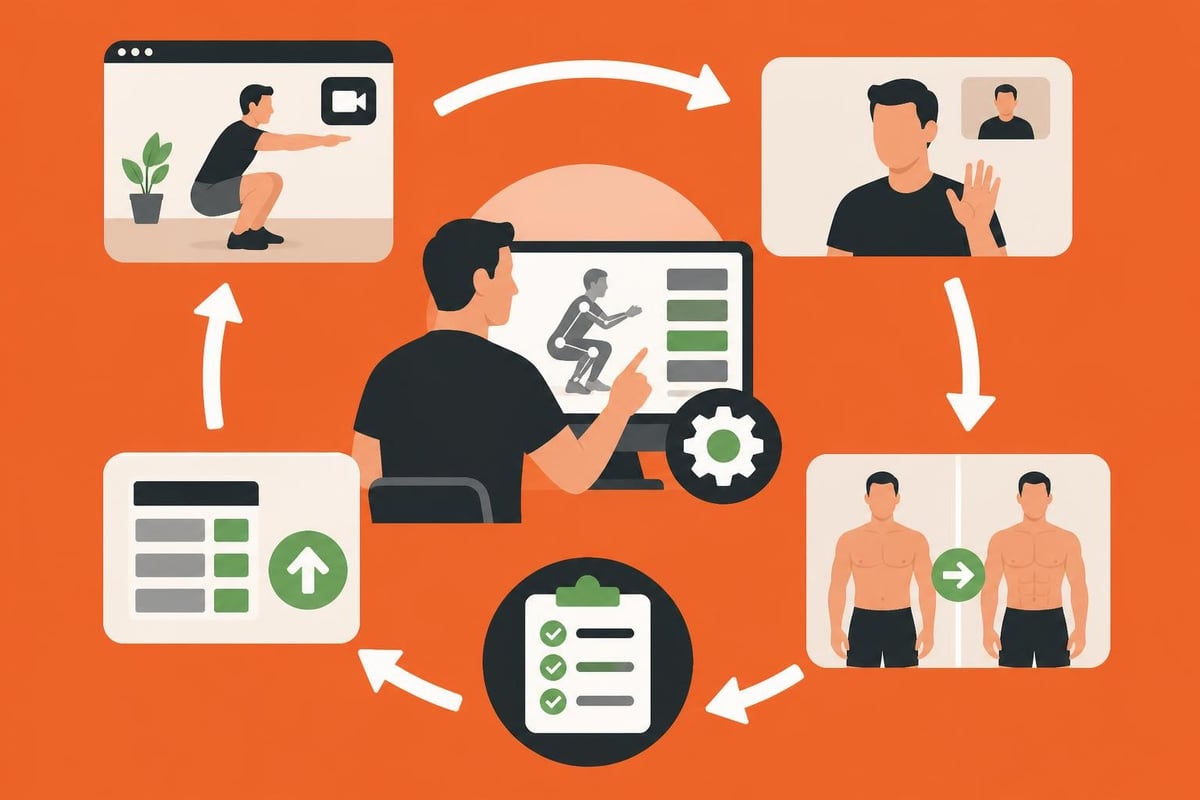
Online 1 1 personal training removes the commute, expands your coach options beyond your zip code, and enables training in your actual environment. You lift in your garage or home gym. Your coach reviews your form via video, provides corrections, and programs around your available equipment. Evidence on telehealth exercise delivery shows remote coaching produces comparable outcomes to in-person sessions when structured properly, particularly for strength training and chronic disease management.
The benefits stack quickly:
Train on your schedule, not a facility's hours
No commute time or fuel expense
Access to specialized coaches regardless of location
Form checks via video with permanent reference material
Immediate messaging for questions between sessions
Program adjustments pushed to your phone in real time
What Separates Real Coaching From App-Based Templates
An app can't ask why you only slept four hours. It can't hear the frustration in your voice when you describe your nutrition falling apart during a business trip. It can't recognize that your "low motivation" is actually accumulated fatigue that requires a deload, not a motivational speech.
Real 1 1 personal training involves a human relationship built on competence and accountability. Your coach knows your injury history, your work stress patterns, your family obligations. When you report a twinge in your lower back, they connect it to the deadlift volume from two sessions ago and the yard work you mentioned over the weekend. That contextual understanding drives intelligent programming.
Feature | App-Based Template | 1 1 Personal Training |
|---|---|---|
Program adjustment | Algorithm-driven, reactive | Coach-driven, proactive |
Form correction | Generic video library | Personalized video analysis |
Accountability | Push notifications | Direct human relationship |
Context awareness | None | Full life integration |
Communication | One-way content | Two-way dialogue |
Injury response | Halt program | Modify and adapt |
The coach-client relationship creates something apps cannot: mutual obligation. You show up because someone is expecting your check-in. You submit your training videos because your coach is reviewing them. You follow the program because you agreed to the standard and someone is holding it with you. That's accountability. That's brotherhood. That's how men actually change.
The Competency Standards That Matter
Not all 1 1 personal training delivers equal value. The industry has low barriers to entry. A weekend certification does not create competence. You need a coach who understands exercise science, program design, risk stratification, and how to modify movements for individual limitations.
NASM's competency framework outlines the baseline: assessment protocols, exercise technique, program design, client interaction, and professional responsibility. A competent coach should conduct proper pre-participation screening before programming, recognize when medical clearance is required, and understand their scope of practice boundaries.
Assessment Before Programming
The first obligation in 1 1 personal training is assessment. Movement screens reveal limitations and asymmetries. Strength baselines establish starting points. Injury history identifies risk factors. Sleep, stress, and nutrition data provide the recovery context. Only after assessment can programming be truly individualized.
A comprehensive initial assessment includes:
Movement screening (squat pattern, hip hinge, overhead mobility)
Strength baselines across fundamental patterns
Medical and injury history review
Current lifestyle and recovery assessment
Goal clarification and timeline discussion
Equipment and environment evaluation
This process takes time. It requires dialogue, not just data collection. A coach who skips assessment and jumps straight to programming is guessing. Guessing creates injury risk and wastes time on ineffective protocols.
Programming for Actual Humans, Not Instagram Reels
Effective 1 1 personal training programming balances intensity with sustainability. The goal isn't to crush you weekly. The goal is progressive overload you can recover from while managing a full life. That requires understanding dose-response relationships and individual recovery capacity.
WHO's physical activity guidelines provide the foundation: adults should perform 150-300 minutes of moderate-intensity aerobic activity weekly, plus muscle-strengthening activities twice weekly. But guidelines are floors, not ceilings, and individual programming must account for training age, injury history, and life stress.
A father in his late thirties with young children, demanding work, and limited sleep cannot train like a 25-year-old single man. His recovery is compromised. His stress is elevated. His available training time is fragmented. Smart programming acknowledges those realities and builds around them.

The Weekly Accountability Architecture
Online 1 1 personal training thrives on structured accountability rhythms. Daily training submission. Mid-week check-in. Weekly call or detailed written review. This cadence keeps both coach and client locked in.
Typical weekly structure:
Monday: Review weekend performance, adjust week's training if needed
Wednesday: Mid-week check-in via message or brief call
Friday: Submit week's training videos and data
Sunday: Coach reviews, provides feedback, loads next week's program
This rhythm creates consistent touchpoints without overwhelming your schedule. You're never more than 48 hours from coach contact. Problems get caught early. Momentum builds through visible progress and regular reinforcement.
For fathers juggling multiple responsibilities, this structure provides clarity. You know exactly what's expected and when. No guessing, no drift, no wondering if you're on track. Just clear standards and regular check-ins.
The Investment Versus The Alternative
1 1 personal training requires financial investment. The question isn't whether it costs money. The question is what the alternative costs. Years of spinning your wheels costs time you don't get back. Injuries from poor programming cost medical bills and training gaps. Lack of results costs confidence and the leadership presence your family needs.
Compare the investment structure:
Option | Monthly Cost | Time Commitment | Result Probability |
|---|---|---|---|
DIY programs | $0-50 | High (trial/error) | Low (no adaptation) |
App-based coaching | $50-150 | Medium | Medium (limited personalization) |
In-person training | $400-800+ | Very high (travel + session) | Medium-High (logistics issues) |
Online 1 1 training | $200-600 | Low (train at home) | High (full personalization) |
The math favors online 1 1 personal training for most men. Lower time commitment than in-person. Higher personalization than apps. Better results than DIY. The investment pays forward in strength gained, fat lost, and leadership capacity built.
When you're evaluating coaches, look beyond price. Assess competency, communication style, and whether they understand your specific context. A cheaper coach who doesn't adapt your program wastes money. A more expensive coach who delivers results and holds standards creates value that compounds across every area of life. Much like how businesses scale by addressing operational bottlenecks through strategic frameworks that install accountability systems, your personal development accelerates when you install the right coaching relationship and infrastructure.
Expectations and Timelines That Reflect Reality
Men want fast results. The culture promises them. The reality requires patience and consistency. 1 1 personal training accelerates progress by eliminating wasted effort and programming mistakes, but it doesn't override biological timelines.
Building muscle requires progressive overload over months. Losing fat requires sustained caloric deficit over weeks. Improving movement quality requires motor pattern repetition over training cycles. A competent coach sets realistic timelines and celebrates appropriate milestones.
The First 90 Days
Expect the first month to focus heavily on assessment, movement pattern establishment, and habit building. You're not training for maximal intensity yet. You're building the foundation that allows intensity to be productive rather than destructive.
Month two increases training stress as your movement patterns solidify and recovery improves. Volume or intensity advances based on your response. Your coach is watching your performance data, recovery markers, and subjective feedback to determine progression rate.
By month three, you're operating in a sustainable rhythm. Training feels normal, not heroic. Results become visible. Strength increases. Body composition shifts. More importantly, the identity shift happens. You're no longer trying to be consistent. You are consistent. That's the transformation that matters most.
The Father Forge's 1-on-1 men's coaching integrates this progression model with weekly accountability calls and custom programming that adapts to your life as a father. The coaching goes beyond exercise prescription to address nutrition planning, mindset development, and leadership growth, recognizing that your physical capacity and mental resilience are inseparable from your effectiveness at home.
The Variables Your Coach Should Monitor
Effective 1 1 personal training requires data. Not obsessive tracking, but intelligent monitoring of key variables that inform programming decisions. Your coach needs enough information to make evidence-based adjustments without burdening you with excessive data collection.
Essential monitoring points:
Training performance (sets, reps, loads, RPE)
Sleep quantity and quality
Subjective recovery and readiness scores
Body weight and measurements (weekly)
Progress photos (bi-weekly or monthly)
Injury or pain reports (immediate)
Stress and life circumstances (ongoing)
This data creates the feedback loop that powers individualization. When your sleep tanks, training volume adjusts. When strength jumps unexpectedly, the program progresses faster. When life stress spikes, intensity moderates. The coach uses information to serve you, not to judge you.

When Remote Coaching Beats In-Person Every Time
Location independence changes everything for specialized coaching. You need a coach who understands training fathers in their late thirties with specific goals. That coach might live three states away. Online 1 1 personal training makes the relationship possible.
The quality of coaching matters infinitely more than physical proximity. A mediocre local trainer cannot compete with an expert coach who specializes in your demographic and goals, even if that expert coaches remotely. Video assessment provides sufficient visual information for form correction. Messaging enables detailed communication. Weekly calls build the relationship.
Research frameworks on individualized exercise prescription emphasize that personalization quality, not delivery mode, determines outcomes. The coach's ability to assess, adapt, and communicate matters more than whether they stand next to you during sets.
The Brotherhood Component Nobody Talks About
1 1 personal training isn't just programming and accountability. It's relationship. For many men, particularly fathers absorbed in work and family obligations, the coaching relationship becomes the only regular space where someone asks how you're actually doing and holds you to a standard.
That relationship provides something most men lack: consistent, competent masculine presence. Your coach isn't trying to be your friend or therapist. But through regular contact focused on your development, a form of brotherhood emerges. You know someone is in your corner. Someone who sees your effort, recognizes your obstacles, and expects you to keep moving forward anyway.
This relational element creates accountability that transcends systems. You don't want to let your coach down because the relationship matters. That emotional investment, when paired with competent programming, drives consistency that purely transactional arrangements cannot match.
The Questions to Ask Before Committing
Not all online 1 1 personal training is created equal. Before committing to a coach, ask specific questions that reveal competency and approach:
What certifications and continuing education do you hold? Look for recognized credentials and ongoing learning.
What's your experience coaching men in my demographic? Specialization matters. A coach experienced with fathers in their thirties understands your context better than a generalist.
How do you handle program adjustments? You want proactive adaptation based on data, not reactive changes only when you complain.
What does the typical weekly communication look like? Understand the rhythm and expectations upfront.
How do you assess and monitor progress? Look for multiple progress markers beyond just scale weight.
What happens if I get injured or need to travel? See how they handle disruptions and program modifications.
The answers reveal whether the coach operates systematically or haphazardly. You want structure, consistency, and clear communication. Anything less wastes your time and money.
The gap between where you are and where you need to be isn't closed by more information or better intentions. It's closed by individualized programming, consistent accountability, and a relationship that holds the standard when everything else slides. That's what 1 1 personal training delivers when done right. The Father Forge builds custom fitness and mindset programs for fathers who refuse to let physical decline compromise their leadership at home, combining personalized training with the accountability structure and brotherhood that makes real transformation sustainable.